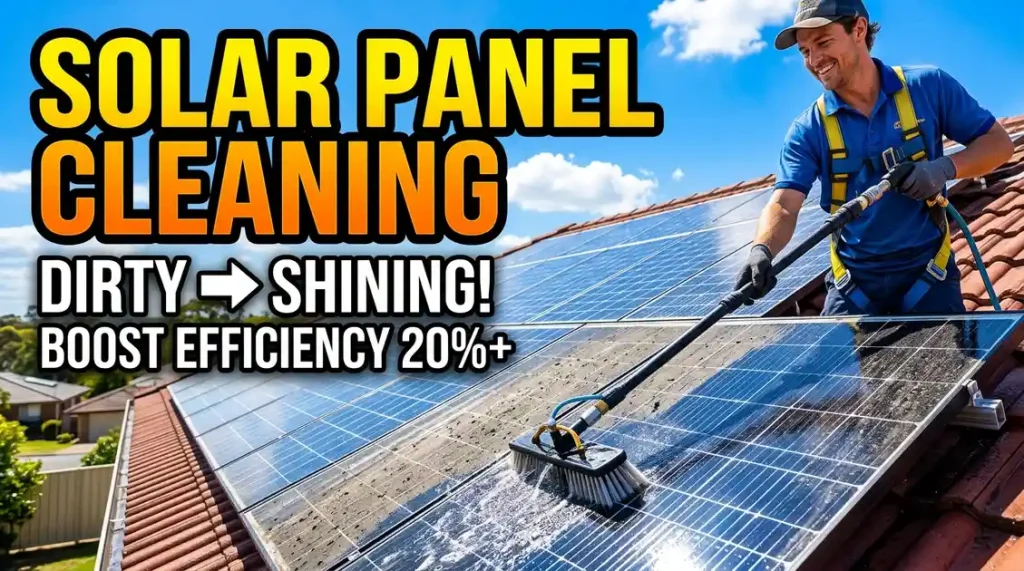
Solar Panel Cleaning in Vancouver, WA: Cost, Schedule & Moss Removal Guide (2026)
Vancouver’s rain doesn’t clean your panels — it can actually make things worse. Here’s exactly how often to clean, what moss really does to your system, real costs, and how to pick a trusted local pro.
Key Takeaways
- Yes, rain isn’t enough. Light Pacific Northwest drizzle can leave a thin mineral film instead of rinsing panels clean.
- Moss and lichen are the biggest local threat — they trap moisture against panel frames and can weaken seals over time.
- Clean twice a year (spring and late summer) for most homes; every 3–4 months near heavy tree cover or wildfire smoke.
- Professional cleaning costs $150–$300 per visit in the Vancouver, WA / Portland metro area.
- A dirty or moss-covered system can lose 5%–25% of its power, with heavier soiling cases reaching 30%+.
Do Solar Panels Need Cleaning in Vancouver, WA?

Yes. Solar panel cleaning Vancouver WA homeowners rely on twice a year keeps output high — rain alone isn’t enough here. It’s a fair guess that a wet climate keeps panels clean on its own, but it’s wrong more often than people think. Rain rinses away loose dust, but it doesn’t remove everything, and light drizzle can even make things worse by mixing with pollen and pollutants into a thin, hazy film. Vancouver and the greater Portland metro deal with a few very specific problems:
- Moss and algae growth, especially on north-facing or low-tilt panels that stay damp for long stretches in fall and winter
- Douglas fir and pine debris — needles, sap, and cones are common in neighborhoods like Cascade Park, Felida, and Hazel Dell
- Wildfire ash and smoke residue, a recurring late-summer issue across Southwest Washington and the Columbia River Gorge
- Spring pollen from alder, maple, and conifer trees
- Hard water spotting left behind after repeated light rain instead of one heavy rinse
This buildup blocks sunlight from reaching your solar cells, which lowers how much electricity your system makes. Industry data on solar performance generally shows dirty or debris-covered panels losing 5% to 25% of their energy output, with moss and heavy shading often landing on the higher end — and some heavily soiled systems reaching 30% or more.
Why Moss Is Different From Ordinary Dirt
Moss and lichen are the most serious long-term threat to solar panels in Southwest Washington, and they behave differently than dust or pollen. Moss does more than block light — it holds moisture against panel frames and mounting hardware, and over time it can compromise the seals that keep water out of the wiring and junction boxes. That’s a repair issue, not just a cleaning issue, if it’s left unchecked for years.
Because of this, moss needs a gentler, more careful approach than a quick rinse:
- Never scrape moss off while it’s dry — this can scratch the panel glass
- Soften moss first with water, then gently rinse it away
- Ask your cleaning provider whether they use a solar-safe treatment to slow moss regrowth on shaded roof sections
- Some larger systems use zinc or copper strips near the top of the array, which naturally slow moss regrowth between cleanings
7 Signs Your Solar Panels Need Cleaning Now
- You can see moss, dark streaking, or a dull film from the ground
- Your monitoring app (Enphase, SolarEdge, Tesla, or similar) shows a production dip that doesn’t match the weather
- Wildfire smoke or ash haze settled over your neighborhood in the last few weeks
- Spring pollen season (roughly April–May) just ended
- It’s been an unusually dry summer stretch with little rain to naturally rinse panels
- You notice water spotting or a chalky mineral film after repeated light rain
- It has been 6 months or more since your last cleaning
How Often Should You Clean Solar Panels in Vancouver, WA?
Twice a year (spring and late summer) — most homes
This timing clears spring pollen before peak summer sun and clears summer dust or ash buildup before the long, dark rainy season sets in.
Every 3–4 months — higher-risk homes
Clean more often if your home:
- Sits under or near large fir, pine, or maple trees (sap, needles, pollen)
- Has a low-slope or north-facing roof section prone to moss and standing moisture
- Is in a heavier tree-canopy neighborhood, like Felida, Salmon Creek, or areas near Lacamas Lake
- Saw visible ash or smoke haze during a recent wildfire season
After specific events, no matter the schedule
- End of wildfire season (typically August–September)
- After spring pollen season (generally April–May)
- After an unusually dry summer stretch
- Anytime you notice moss, dark streaking, or a dull film starting to form
Simple test: if you can spot moss, dark spotting, or a dusty film from the ground, your system has likely already lost meaningful output. It’s time to clean.
How Much Does Solar Panel Cleaning Cost in Vancouver, WA?
Solar Panel Cleaning Vancouver WA: 2026 Price Summary
Local pricing across the Vancouver, WA / Portland metro area breaks down like this in 2026:
| Pricing Model | Typical Range | Best For |
|---|---|---|
| Per visit (flat rate) | $150 – $300 | Standard 15–25 panel residential system |
| Per panel | $8 – $20 per panel | Larger or non-standard arrays |
| Annual plan (2 visits) | $390 – $600 per year | Homeowners on the standard twice-a-year schedule |
| Quarterly plan (4 visits) | $550 – $900 per year | Moss-prone roofs, heavy tree canopy, or wildfire-exposed homes |
What changes your price up or down:
- Roof pitch and access — Vancouver’s hillier neighborhoods often have steeper roofs, which need extra safety gear
- Moss severity — heavy, long-neglected moss growth takes longer and may need a treatment step, not just a rinse
- Number of panels and layout — split arrays or multiple roof planes take more time
- Access — gated or hard-to-reach properties can add a trip fee
- Bundled services — pairing solar cleaning with gutter or roof moss treatment often lowers the per-visit price
3 Ways to Get Your Solar Panels Cleaned
1. Professional Solar Panel Cleaning (recommended for most roofs)
This is the safest, most thorough option, especially given how common steep, moss-prone roof sections are in this region. A qualified local provider will typically use:
- Deionized, spot-free water systems to avoid streaking or mineral buildup
- Soft brushes and squeegees safe for solar glass and anti-reflective coatings
- A moss and algae treatment made for solar equipment, not a standard roof cleaner, which can be too harsh
- Proper fall protection and roof-safety equipment for steep Pacific Northwest roof pitches
2. DIY Cleaning (use caution)
DIY can be reasonable for single-story homes with easy, low-pitch roof access or ground-mounted systems. See the step-by-step guide below, and pay close attention to the moss-handling rules.
3. Automated Cleaning or Anti-Moss Systems
Larger residential arrays and commercial installs sometimes use automated rinse systems or zinc/copper strips to slow moss regrowth between cleanings. These cost more upfront but can meaningfully cut down how often manual cleaning is needed on shaded, moss-prone roof sections.
Safe DIY Solar Panel Cleaning: Step-by-Step
Only attempt this on a low-pitch, single-story roof or a ground-mounted system. Skip DIY entirely on steep or multi-story roofs, which are common throughout Vancouver’s hillier neighborhoods.
- Pick a cool, overcast day. Never clean in direct sun — cold water on hot glass can cause micro-cracking.
- Check your system manual for whether your installer recommends powering down before cleaning.
- Rinse first. Use a garden hose on a gentle stream to loosen loose dust, pollen, or ash.
- Handle moss carefully. Never scrape it off dry. Soften it with water first, then gently rinse.
- Wash gently. Use plain water or a mild soap made specifically for solar glass, applied with a soft-bristle brush or squeegee on an extension pole.
- Never use a pressure washer. It can damage seals and worsen existing micro-cracks.
- Rinse again with plain water to avoid streaking or mineral spots.
- Check your monitoring app over the next few days to confirm output improved.
Safety line: avoid DIY entirely on steep or multi-story roofs. Vancouver’s hillier neighborhoods make ladder work riskier than it looks — the savings are never worth a fall or a cracked panel.
Is It Worth It to Get Solar Panels Cleaned?
For the vast majority of Vancouver, WA homeowners, yes. Here’s how to check the math for your own system:
- Check your production data. Most monitoring platforms (Enphase, SolarEdge, Tesla, etc.) let you compare output before and after a cleaning or a heavy rain.
- Estimate the energy loss. Even a conservative 10% output loss on a typical 7–8kW residential system can add up to hundreds of lost kilowatt-hours a year — often $150–$400+ in wasted electricity value, depending on your rate with Clark Public Utilities.
- Compare that to the cleaning cost. At $150–$300 twice a year, most homeowners break even or come out ahead on energy savings alone, not counting the added protection for your equipment.
Additional reasons cleaning is worth it in this region specifically:
- Moss prevention protects your roof and panels. Left unchecked, moss traps moisture against frames and mounting hardware, leading to long-term wear.
- It protects your warranty. Many manufacturers require documented maintenance to keep performance warranties valid.
- It extends system lifespan. Persistent moss, sap, or debris buildup can create “hot spots” that permanently degrade solar cells over time.
- It simplifies inspections. A clean surface makes it far easier to spot cracks, loose wiring, or micro-fractures early, before they turn into costly repairs.
The main exception: a very small system, a roof section under heavy shade most of the day regardless of cleanliness, or a roof that rarely develops moss or debris. Even then, an annual check is still worthwhile.
Does Cleaning Protect Your Solar Warranty?
Yes, in many cases. Most manufacturers offer a performance warranty covering 20–25 years, and some include a maintenance clause requiring proof of regular cleaning and inspection to honor a claim if output drops below the guaranteed level. In Vancouver specifically, unmanaged moss growth can also raise questions about improper maintenance if a warranty claim is ever filed. Two easy habits protect you:
- Keep receipts or invoices from every professional cleaning or moss treatment
- Photograph your panels before and after each DIY cleaning, with a timestamp
Improper cleaning techniques — like a pressure washer or dry-scraping moss — can also void a warranty outright, so confirm your provider’s methods before hiring them.
How to Choose a Solar Panel Cleaning Company in Vancouver, WA
Not every pressure-washing company is equipped to handle solar glass or moss safely. Confirm these boxes before you hire anyone:
- They use deionized or purified water, not straight tap water
- They use soft brushes made for solar glass, never stiff bristles or scrapers
- They never use a pressure washer on the panels themselves
- They have specific experience treating moss and lichen on solar equipment, not just standard roof moss removal
- They carry liability insurance and proper fall-protection gear for steep Pacific Northwest roofs
- They can show recent local reviews or references from Clark County homeowners
- They give you a written invoice you can keep for warranty documentation
Areas We Cover Near Vancouver, WA
Tree canopy and moss exposure vary block by block across Southwest Washington. This guide applies across the wider service area, including:
Homes near Lacamas Lake, under heavy fir or maple canopy, or on north-facing low-slope roofs should lean toward the 3–4 month cleaning schedule instead of the standard twice-a-year schedule, since moss and standing moisture build up faster in shaded spots.
Quick Answer Summary
| Question | Short Answer |
|---|---|
| Do solar panels need cleaning? | Yes — light Pacific Northwest rain doesn’t remove moss, sap, or ash residue. |
| How often in Vancouver, WA? | Twice a year for most homes; every 3–4 months near heavy tree cover or moss-prone roofs. |
| How to clean them? | Professional cleaning is safest, especially on steep or moss-prone roofs; DIY only for easy, low-pitch access. |
| Cost of professional cleaning? | $150–$300 per visit, or $8–$20 per panel, in the Vancouver, WA / Portland metro area. |
| Is it worth it? | Yes — most homeowners recover the cost through restored output, plus moss and warranty protection. |
Frequently Asked Questions
How much does solar panel cleaning cost in Vancouver, WA?
Most residential solar panel cleaning in the Vancouver, WA / Portland metro area costs $150 to $300 per visit, or about $8 to $20 per panel, depending on system size, roof access, and moss severity.
Does rain clean solar panels well enough in the Pacific Northwest?
No. Heavy rain rinses away loose dust, but light, frequent drizzle often leaves behind a thin mineral film. Rain also doesn’t remove moss, sap, or wildfire ash residue.
Is moss actually harmful to solar panels?
Yes. Moss blocks sunlight and holds moisture against panel frames and mounting hardware, which over time can weaken the seals protecting the wiring and junction boxes.
How often should I clean solar panels in Vancouver, WA?
Most homes should schedule cleaning twice a year, in spring and late summer. Homes under heavy tree canopy, near moss-prone north-facing roof sections, or in wildfire-affected areas should move to every 3 to 4 months.
Can I remove moss from my solar panels myself?
Only with care. Never scrape moss off while it’s dry, since this can scratch the glass. Soften it with water first, then gently rinse. For heavy or long-established moss, a professional with a solar-safe treatment is the safer choice.
Will cleaning my solar panels void my warranty?
Improper methods can. Pressure washers, abrasive scrubbing, or dry-scraping moss can void a manufacturer’s warranty. Many manufacturers also require documented maintenance to honor a performance warranty claim, so keeping receipts is a good habit.
How much energy do dirty or moss-covered solar panels lose?
Industry data commonly shows a 5% to 25% drop in output from dirt and moss buildup, with heavily soiled or moss-covered systems sometimes losing 30% or more.