Solar Panel Cleaning in Myrtle Beach: Cost, Schedule & Best Methods (2026)
Salt air, pine pollen, and hurricane dust build up fast on the Grand Strand. Here’s exactly how often to clean your panels, what it should cost, and how to pick a safe, trusted local pro.
Key Takeaways
- Yes, solar panels need cleaning. Rain washes away loose dust but not salt film, pollen, or bird droppings.
- Clean every 6 months for most Myrtle Beach homes; every 3–4 months if you’re near the coast, under trees, or on a low-slope roof.
- Professional cleaning costs $150–$300 per visit in the Myrtle Beach area, or about $8–$20 per panel.
- A dirty system can lose 5%–25% of its power, so cleaning usually pays for itself in restored energy alone.
- DIY is safe only for ground-mounted or easy, single-story roofs, using plain water and a soft brush — never a pressure washer.
Do Solar Panels Need Cleaning in Myrtle Beach?

Yes. Solar panel cleaning Myrtle Beach homeowners schedule twice a year keeps output high — rain alone doesn’t cut it here. Solar panels are built to be low-maintenance, and rain does rinse off a lot of everyday dust. But rain alone does not remove everything, especially near the coast. In Myrtle Beach, your panels deal with a few extra problems that inland homes do not face as often:
- Salt air residue from the Atlantic, which leaves a thin, hazy film on the glass
- Pine pollen, which coats roofs across Horry County every spring
- Bird droppings and tree sap, which create “hot spots” that rinse water cannot break down
- Humidity-driven algae or mildew film, common on panels with a low tilt angle
- Construction and road dust, especially in growing areas like Carolina Forest and Market Common
Any of this buildup blocks sunlight from reaching your solar cells, which lowers how much electricity your system makes. Research on panel performance commonly shows that dirty panels can lose 5% to 25% of their energy output, depending on how much grime has built up and for how long. In a coastal, high-pollen market like the Grand Strand, the higher end of that range is common every spring and right after hurricane season.
7 Signs Your Solar Panels Need Cleaning Now
You do not always need to wait for a set schedule. Watch for these warning signs between cleanings:
- You can see visible haze, streaks, or a dull film on the glass from the ground
- Your monitoring app (Enphase, SolarEdge, Tesla, or similar) shows a production drop that isn’t explained by weather
- It’s been more than 4 weeks with no real rainfall
- Pine pollen season (typically March–April) just ended
- A tropical storm or hurricane recently passed through
- You spot bird droppings, sap, or leaf debris sitting on one section of a panel
- It has been 6 months or more since your last professional or DIY cleaning
How Often Should You Clean Solar Panels in Myrtle Beach?
For most homes on the Grand Strand, here is the general rule:
Twice a year (every 6 months) — most homes
This works well for an average roof that isn’t shaded by heavy trees and isn’t right on the oceanfront.
Every 3–4 months — higher-exposure homes
Clean more often if your home is:
- Directly on the oceanfront or within a mile of the coast (heavier salt buildup)
- Under or near pine, oak, or palm trees (sap, pollen, droppings)
- On a low-slope roof, where debris doesn’t slide off on its own
- Near a construction zone or unpaved road
After specific events, no matter the schedule
- Right after pine pollen season ends (typically March–April)
- After a tropical storm or hurricane
- After 4+ weeks with no rain
- Any time your monitoring app shows a sudden output drop
Simple rule of thumb: if you can see grime, streaks, or a dull haze from the ground, it’s already cutting into your energy output. It’s time to clean.
How Much Does Solar Panel Cleaning Cost in Myrtle Beach?
Solar Panel Cleaning Myrtle Beach: 2026 Price Summary
Local pricing tracks closely with national averages for coastal markets. Here’s the current 2026 breakdown:
| Pricing Model | Typical Range | Best For |
|---|---|---|
| Per visit (flat rate) | $150 – $300 | Standard 15–25 panel residential system |
| Per panel | $8 – $20 per panel | Larger or non-standard arrays |
| Annual plan (2 visits) | $390 – $600 per year | Homeowners who want a set-it-and-forget-it schedule |
| Quarterly plan (4 visits) | $550 – $900 per year | Oceanfront homes, homes under heavy trees |
What changes your price up or down:
- Roof height and pitch — steep or second-story roofs need extra safety gear, which adds cost
- Number of panels and layout — split arrays or multiple roof planes take longer
- Buildup level — heavy pollen crust or long-neglected panels need extra passes
- Access — gated communities or hard-to-reach roofs can add a trip fee
- Bundled services — pairing solar cleaning with gutter or roof cleaning often lowers the per-visit price
3 Ways to Get Your Solar Panels Cleaned
1. Professional Solar Panel Cleaning (recommended for most roofs)
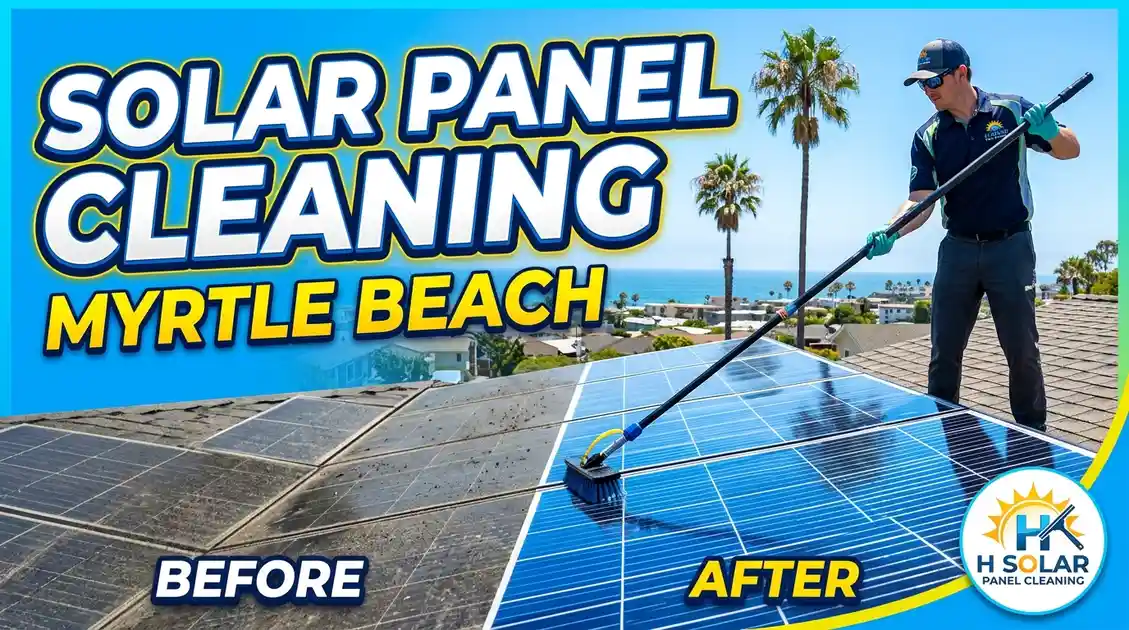
A local Myrtle Beach solar cleaning crew is the safest, most effective choice for roof-mounted systems. Trained crews use:
- Deionized, purified water systems (no mineral spots or streaking)
- Soft, non-abrasive brushes made specifically for solar glass
- Proper harnessing and roof-safety equipment
- Panel-safe cleaning solutions that won’t damage the anti-reflective coating
2. DIY Cleaning (use caution)
If your panels are ground-mounted or on a single-story, low-pitch roof, DIY can work — but only with the right approach. See the step-by-step guide below.
3. Automated Cleaning Systems
Some newer installs include robotic or sprinkler-based cleaning systems. These cost more upfront but cut down on manual cleanings long-term. This option usually only makes financial sense for larger residential arrays or commercial solar systems.
Safe DIY Solar Panel Cleaning: Step-by-Step
Only attempt this if your roof is low-pitch, single-story, or your panels are ground-mounted. If you need a ladder, have a steep roof, or feel unsure about roof safety, skip to hiring a pro.
- Pick the right time. Clean early morning or on an overcast day. Never clean in direct midday sun — cold water on hot glass can cause micro-cracks.
- Turn off the system if your installer’s manual recommends it before cleaning (check your documentation first).
- Rinse first. Use a garden hose on a gentle stream to loosen loose dust and pollen before you touch the glass.
- Wash gently. Use plain water or a mild, non-abrasive soap made for solar glass. Apply with a soft-bristle brush or squeegee on an extension pole.
- Never use a pressure washer. High pressure can crack seals and damage the anti-reflective coating.
- Rinse again with plain water to prevent streaking or mineral spots.
- Let panels air dry and check your monitoring app over the next few days to confirm output improved.
Safety line: never walk directly on your panels, and never climb onto a steep or high roof without proper fall protection. The savings from DIY are never worth a fall or a cracked panel.
Is It Worth It to Get Solar Panels Cleaned?
In almost every case, yes. Here’s the simple math you can run yourself:
- Check your production drop. Most monitoring apps show daily and monthly output. Compare a dusty stretch to a post-rain or post-cleaning period.
- Estimate the energy loss. Even a conservative 10% loss on a typical 8kW residential system can mean hundreds of lost kilowatt-hours a year — often $150–$400+ in wasted electricity value, depending on your utility rate.
- Compare that to the cleaning cost. At $150–$300 twice a year, most homeowners break even or come out ahead on energy savings alone — before counting the added benefit of protecting the equipment.
Beyond direct savings, regular cleaning also:
- Protects your warranty. Some manufacturers require documented maintenance to keep performance warranties valid.
- Extends panel lifespan. Grime from bird droppings and tree sap can cause “hot spots” that permanently degrade cells over time.
- Makes inspections easier. Clean panels make it much easier for you or a technician to spot cracks, loose connectors, or wiring issues early.
The one scenario where cleaning may not be worth it: a very small system, panels that are heavily shaded most of the day anyway, or a stretch of consistently heavy summer rainfall — which isn’t the norm here outside of peak summer storms.
Does Cleaning Protect Your Solar Warranty?
Yes, in many cases. Most solar panel manufacturers offer a performance warranty guaranteeing a certain output level over 20–25 years. Some of these warranties include a maintenance clause, meaning you may need proof of regular cleaning and inspection to file a valid claim if output drops below the guaranteed level. Two easy habits protect you:
- Keep receipts or invoices from every professional cleaning
- Photograph your panels before and after each DIY cleaning, with a timestamp
Check your specific installer paperwork or manufacturer documentation, since maintenance requirements vary by brand.
How to Choose a Solar Panel Cleaning Company in Myrtle Beach
Not every power-washing company is set up to clean solar glass safely. Before you hire anyone, confirm they check these boxes:
- They use deionized or purified water, not straight tap water
- They use soft brushes made for solar glass, never stiff bristles or scrapers
- They never use a pressure washer on the panels themselves
- They carry liability insurance and proper roof-safety equipment
- They can show recent local reviews or references from Myrtle Beach or Horry County homeowners
- They give you a written invoice you can keep for warranty documentation
- They’re upfront about pricing before the work starts, with no surprise add-on fees
Areas We Cover Near Myrtle Beach
Coastal exposure varies block by block along the Grand Strand. This guide applies across the wider service area, including:
Oceanfront and near-coast homes in any of these areas should lean toward the 3–4 month cleaning schedule instead of the standard 6-month schedule, since salt exposure is higher that close to the Atlantic.
Quick Answer Summary
| Question | Short Answer |
|---|---|
| Do solar panels need cleaning? | Yes — rain alone doesn’t remove salt film, pollen, or sap. |
| How often in Myrtle Beach? | Every 6 months for most homes; every 3–4 months near the coast or under trees. |
| How to clean them? | Professional cleaning is safest; DIY only for low, easy-access roofs. |
| Cost of professional cleaning? | $150–$300 per visit, or $8–$20 per panel, in the Myrtle Beach area. |
| Is it worth it? | Yes — most homeowners recover the cost through restored energy output alone. |
Frequently Asked Questions
How much does solar panel cleaning cost in Myrtle Beach, SC?
Most residential solar panel cleaning in the Myrtle Beach area costs $150 to $300 per visit, or about $8 to $20 per panel, depending on system size, roof access, and how much buildup has accumulated.
How often should I clean solar panels in a coastal climate?
Most Myrtle Beach homes should schedule cleaning every 6 months. Oceanfront homes, homes under trees, or homes on low-slope roofs should move to every 3 to 4 months because of extra salt, pollen, and sap exposure.
Can I clean my own solar panels?
Yes, if your panels are ground-mounted or on a single-story, low-pitch roof. Use plain water, a soft brush or squeegee, and never a pressure washer. Skip DIY entirely for steep or second-story roofs.
Does rain clean solar panels well enough on its own?
No. Rain washes away loose dust but leaves behind salt film, pollen residue, bird droppings, and tree sap. These need an active cleaning to fully remove.
Will dirty solar panels void my warranty?
Not directly, but some manufacturers require documented maintenance to honor a performance warranty claim. Keeping cleaning receipts protects you if you ever need to file a claim.
How much energy do dirty solar panels lose?
Studies commonly show a 5% to 25% drop in output from dirt buildup, with the higher end common in high-pollen, high-humidity markets like the Grand Strand during spring and after hurricane season.
Is professional solar panel cleaning worth the cost?
In almost every case, yes. A conservative 10% output loss on a typical system can waste $150 to $400 or more a year in electricity, which usually covers or exceeds the cost of two annual professional cleanings.