Solar Cost Guide · Updated for 2026
Are Solar Panels Worth It in 2026? Real Costs, Payback & Savings by State
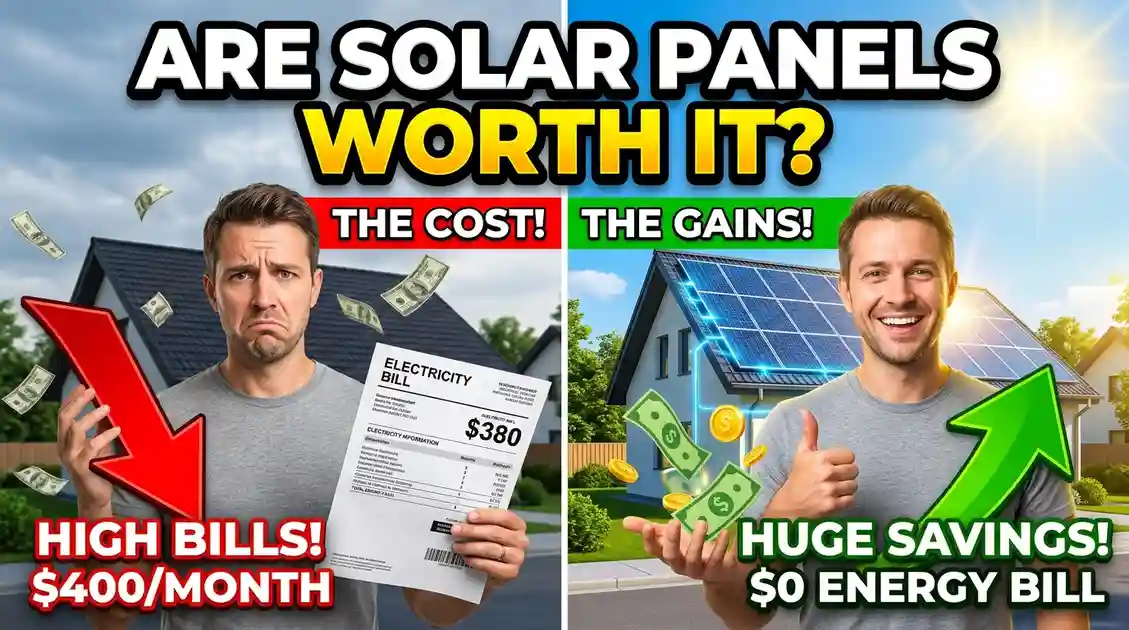
Are solar panels worth it in 2026? Yes, for most homeowners who pay over $130 a month for electricity, own their roof, and plan to stay put for at least 7 years. Without the federal tax credit, the average payback period is now 6 to 13 years, and panels keep saving money for 25 years or more.
Solar panel prices have dropped a lot over the last ten years. But 2026 brought a new twist: the federal tax credit is gone for most buyers, so the price you pay went up even though panel prices themselves stayed low. This guide walks through real 2026 numbers — cost, payback, state-by-state savings, and the honest downsides — so you can answer the question for your own home, not just in general.
What’s in this guide
- How much do solar panels cost in 2026?
- Solar payback period: how long until panels pay for themselves?
- Benefits of solar panels: the real advantages
- Do solar panels actually help the environment?
- The real cons of solar panels (honest downsides)
- The biggest misconception: “you still get 30% back”
- Cash vs. loan vs. lease: what each one really costs
- What is net metering, and why it changes your payback
- Does your roof direction and shading really matter?
- Can renters or apartment dwellers go solar?
- Do solar savings change with the seasons?
- Solar panels vs. other ways to go green
- Are solar panels worth it in my state?
- Are commercial solar panels worth it?
- When solar is not worth it
- How to size a solar system
- Maintenance and lifespan: what to expect
- Frequently asked questions
1. How Much Do Solar Panels Cost in 2026?
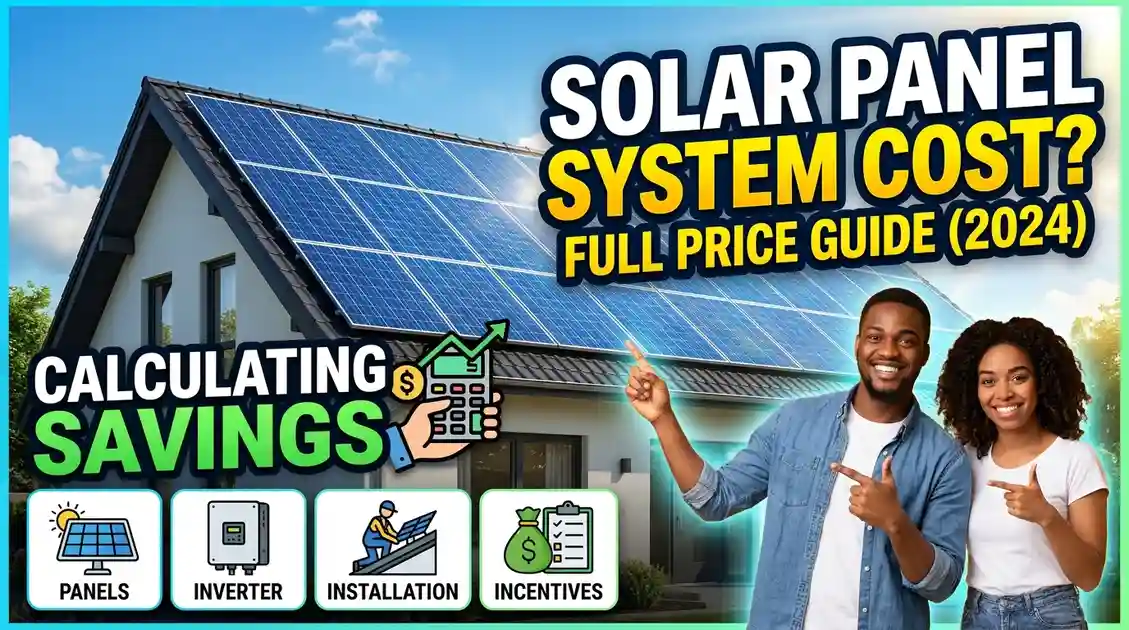
Here is what a typical cash-purchase system costs before any state incentives:
| System Size | Typical Homes It Fits | Cost Before Incentives | What It Powers |
|---|---|---|---|
| 5 kW | Small home, low usage | $14,000 – $17,000 | ~600–700 kWh/month |
| 7.5 kW | Average U.S. home | $19,000 – $24,000 | ~900–1,000 kWh/month |
| 8 kW | Average home + some extra | $22,000 – $27,000 | ~1,000–1,100 kWh/month |
| 10 kW | Larger home or home with EV | $27,000 – $33,000 | ~1,300 kWh/month |
| 12 kW | Big home, pool, or heavy AC use | $30,000 – $37,000 | ~1,500 kWh/month |
Prices per watt usually land between $2.50 and $3.20. Your final number depends on your roof shape, your state, and whether you add a battery (batteries add $7,000 or more).
2. Solar Payback Period: How Long Until Panels Pay for Themselves?
The payback period is the number of years it takes for your electric bill savings to equal what you spent. This is the number most people really want when they ask, are solar panels worth it.
Here’s the simple formula:
Payback period = Net system cost ÷ Annual electric bill savings
In 2026, without the federal credit, most homeowners see a payback period of 6 to 13 years, with an average around 8 to 9 years for people who buy a system in cash.
Payback period by state (8 kW system, no federal credit)
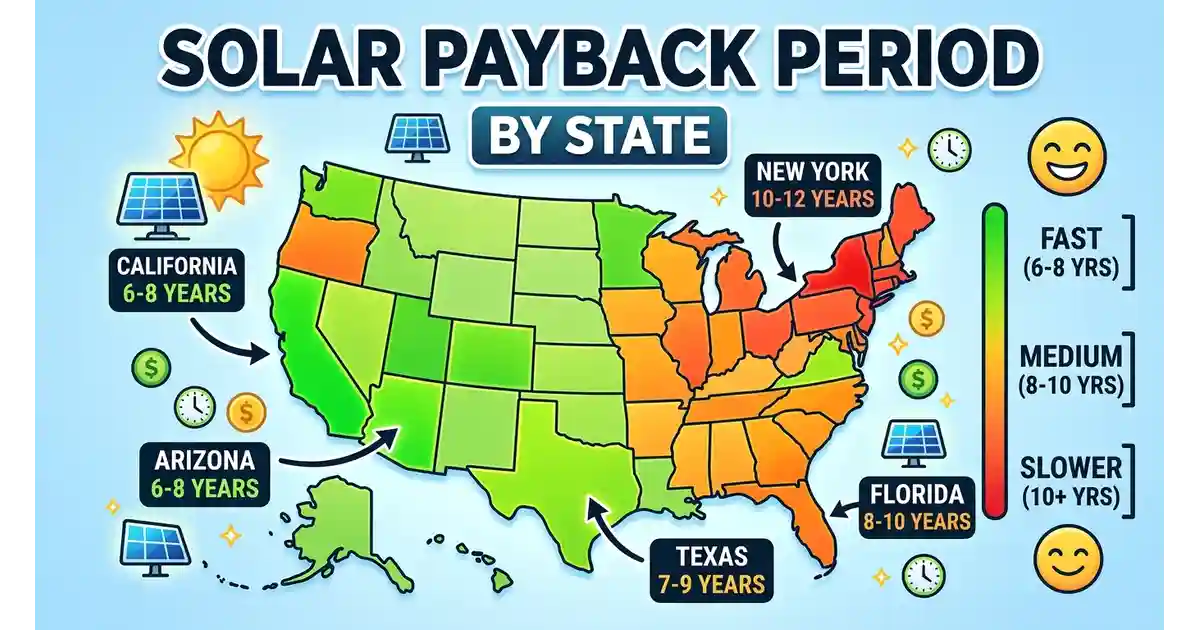
Lower electric rates mean a longer wait to break even. This is the single biggest factor in whether solar makes sense for you — more important than panel brand or roof angle.
3. Benefits of Solar Panels: The Real Advantages
The benefits of solar panels and the advantages of solar panels are the same thing, and these are the real, measurable ones — not marketing talk.
- Lower electric bills. Most homeowners cut their bill by $100 to $150 a month once solar covers most of their usage.
- Protection from rising electric rates. Utility rates have climbed faster than inflation for several years in a row. Once your panels are paid off, your power cost is locked in near zero, no matter how high grid prices go.
- Home value increase. Homes with solar tend to sell for about 4% to 6.8% more, and often sell faster than similar homes without solar. On a $400,000 home, that’s roughly $16,000 to $27,000 in added value.
- Long warranty life. Panels are warrantied for 25 years and often keep working well past 30 years. Even at low output, that’s decades of savings after the system is paid off.
- Energy independence. With or without a battery, solar reduces how much you depend on the grid and on future price hikes.
- Real lifetime savings. Homeowners who buy their system typically save $25,000 to $90,000 over 25 years in avoided electric bills, and sometimes more in high-rate states.
4. Do Solar Panels Actually Help the Environment?
Yes. A typical home solar system offsets about 3 to 4 metric tons of carbon dioxide every year — roughly the same as planting 100 trees a year, based on EPA greenhouse gas equivalency data.
Money is not the only reason people go solar. Panels make electricity with no smoke, no fuel, and no moving parts. Here’s what that means in plain terms:
- Cleaner power at home. Each kilowatt-hour your panels make is a kilowatt-hour your utility does not have to burn coal or gas to produce.
- Lower carbon footprint. An average home system cuts about 3 to 4 metric tons of CO₂ per year — similar to taking one gas-powered car off the road for about eight months.
- Less land impact per unit of power. Solar panels produce more usable energy per acre than growing biofuel crops or new tree planting used purely as a carbon offset.
- No emissions while running. Unlike a generator, solar panels make electricity silently and without burning anything, day after day, for 25-plus years.
If cutting your carbon footprint matters to you as much as saving money, this is a real, ongoing benefit — not just a bullet point on a sales flyer.
5. The Real Cons of Solar Panels (Honest Downsides)
Together with Section 3, this is the full pros and cons of solar panels picture — most sites only show you half of it.
- No more federal tax credit for buyers. As of January 1, 2026, homeowners who buy a system with cash or a loan get $0 back from the federal government. This alone made payback periods 3 to 4 years longer than they were in 2024. More on this in Section 6.
- High upfront cost. Even with prices down, you’re still spending $19,000 to $30,000+ for an average system. Financing this adds interest, which cuts into your savings.
- It’s not free money in year one. You won’t see real profit until after the payback period ends. Before that, you’re just breaking even.
- Inverter replacement. Panels last 25-30 years, but inverters usually last only 10-15 years. Budget $1,000 to $3,000 for one replacement during the system’s life.
- Shading kills output. If trees or buildings block your roof for more than 4 hours a day during peak sun, your savings drop a lot. Some homes simply aren’t good candidates.
- Selling too soon can lose money. If your payback period is 12 years and you sell your home in year 5, you may not fully recover your investment, even with the home value bump.
- Roof condition matters. If your roof needs replacing within 5 years, you should re-roof first. Removing and reinstalling panels for a new roof adds cost later.
6. The Biggest Misconception: “You Still Get 30% Back”
This is the most common wrong idea people have about solar in 2026, and it trips up a lot of homeowners.
For years, the federal government gave a 30% tax credit to anyone who bought solar panels. That program was called the Residential Clean Energy Credit. In 2025, a new law (the One Big Beautiful Bill Act) ended this credit early — seven years ahead of schedule.
| Ownership Type | 2025 Rule | 2026 Rule |
|---|---|---|
| Cash or loan purchase | 30% federal credit | $0 federal credit |
| Solar lease or PPA | 30% credit (to the leasing company) | Credit still applies through 2027, passed along as lower monthly rates |
| Commercial/business systems | 30% credit | Still active if construction starts before July 2026 |
So if you’re planning to buy your system outright in 2026, do not count on getting 30% back. Many solar company websites still advertise the old credit — always ask your installer directly whether the number they quote you includes anything that no longer exists. You can check current federal rules directly at irs.gov and energy.gov.
If the tax credit was the main reason solar made sense for you, a lease or PPA (where a company owns the panels and you pay a lower monthly rate) is now the more realistic path to that same savings.
7. Cash vs. Loan vs. Lease: What Each One Really Costs
How you pay for solar changes your real savings just as much as the sticker price does. Here’s the honest comparison:
| Payment Method | Upfront Cost | Who Owns the Panels | Real Cost Impact |
|---|---|---|---|
| Cash purchase | Full price today | You | No interest — the fastest way to reach payback and the most total savings over 25 years |
| Solar loan | $0–low down payment | You | Interest rates usually run 4% to 9%, which adds $3,000–$10,000+ over the loan term |
| Lease or PPA | $0 down | Leasing company | Lower monthly payment now, but smaller total savings and no ownership value at resale |
A solar loan can still make sense if you don’t have $20,000+ in cash, but always compare the total interest paid against a few extra years of payback before signing. Ask your lender for the total repayment amount, not just the monthly payment.
8. What Is Net Metering, and Why It Changes Your Payback
Net metering is the billing rule your utility uses to credit you for extra solar power you send back to the grid. A strong policy can shave years off your payback; a weak one can add them.
Most homes make more solar power at midday than they use, and less at night. Net metering is simply the rule that decides what happens to that extra daytime power.
- Full retail net metering credits you the same rate you’d pay to buy power, making your payback fastest.
- Reduced or “net billing” rules, like California’s NEM 3.0, pay less for exported power, which is why many California homeowners now add a battery to use more of their own solar instead of selling it cheaply.
- No net metering means any extra power you make is basically wasted unless you store it in a battery.
Before buying, ask your installer to show you your utility’s exact net metering or net billing rule in writing. This one policy can matter more to your savings than the brand of panel you choose.
9. Does Your Roof Direction and Shading Really Matter?
Yes, and it’s one of the most overlooked factors. Roof orientation changes how many sun hours your panels actually get:
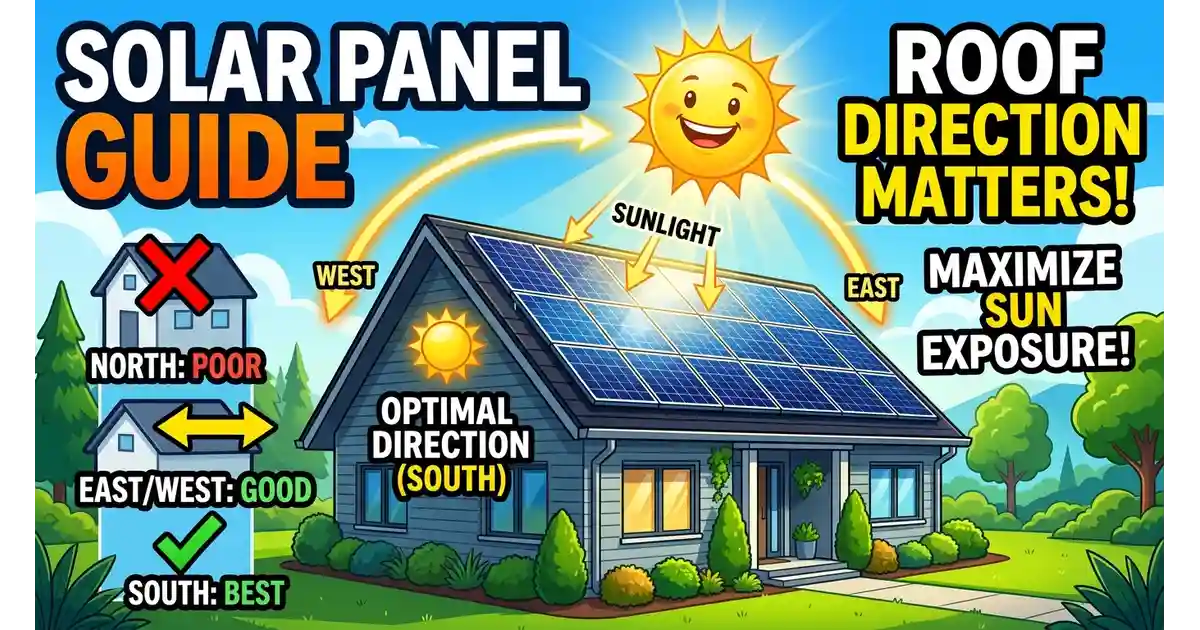
- South-facing roofs get the most direct sun in the U.S. and produce the most power for the same number of panels.
- West-facing roofs are a close second and often shift more production into the afternoon, which can match your usage better.
- East-facing roofs work fine but usually produce a bit less than south or west.
- North-facing roofs in the Northern Hemisphere get the least sun and are rarely recommended unless the rest of the roof is unusable.
Shading matters even more than direction. A single shaded panel can drag down the output of 10 to 20 other panels wired to it, so a few hours of tree shade in the afternoon can hurt your savings far more than facing east instead of south.
10. Can Renters or Apartment Dwellers Go Solar?
Renters can rarely install rooftop panels, but many can still save through a community solar subscription with no roof and no purchase required.
If you rent your home or live in a condo or apartment, buying rooftop panels usually is not an option — you don’t own the roof, and moving the system later is expensive and impractical. Two realistic paths still exist:
- Community solar. You subscribe to a share of a local solar farm and get a credit on your electric bill, often 5% to 15% savings, with no equipment on your property.
- Ask your landlord. Some landlords are open to installing solar if you offer to split the cost or sign a longer lease, since it also raises the property’s value.
11. Do Solar Savings Change With the Seasons?
Yes. Seasonal changes impact on solar panel electricity savings more than most new solar owners expect.
- Summer: Long, sunny days mean panels produce the most power. Many homes build up extra credits during these months.
- Winter: Shorter days and a lower sun angle can cut output by 40-60% compared to summer, depending on your area.
- Cloudy or rainy days: Panels still work, but output can drop 60-80% on the darkest days.
- Snow: A light dusting cuts output some; heavy snow sitting on panels can block production almost completely until it melts or is cleared.
This is why most utilities use annual “true-up” billing instead of judging your system month to month. A slow winter month doesn’t mean something is wrong — it means your summer credits are doing their job.
12. Solar Panels vs. Other Ways to Go Green (Quick Comparison)
| Option | Upfront Cost | Who Owns It | Best For |
|---|---|---|---|
| Buy solar (cash/loan) | $19,000–$30,000+ | You | Long-term homeowners with good sun and high bills |
| Solar lease/PPA | $0 down | Leasing company | People who want savings now without a big purchase |
| Community solar | $0 | Solar farm operator | Renters or homes with bad roofs/shade |
| No solar | $0 | N/A | Homes selling soon, low electric bills, heavy shade |
13. Are Solar Panels Worth It in My State?
Are solar panels worth it in my state? It depends almost entirely on your local electric rate — the higher your rate, the faster panels pay for themselves. Your state’s net metering rule and average sun hours matter too.
| State | Avg. Rate (¢/kWh) | Quick Verdict |
|---|---|---|
| California | ~31.8 | Yes — very high rates give one of the fastest paybacks (~6 years), even with NEM 3.0’s lower export credits |
| Texas | ~14.8 | Yes for high-usage homes — a moderate rate offset by strong sun and heavy AC demand |
| Florida | ~14.0 | Yes — a below-average rate is offset by excellent year-round sun, giving a payback around 9-11 years |
| Illinois | ~17.0 | Yes — above-average rates and a solid state incentive program support payback around 9-10 years |
| Massachusetts | ~30.9 | Yes — one of the fastest paybacks in the country, around 7 years |
| New York (NY) | ~28.6 | Yes — high rates make payback around 7-9 years |
| Connecticut | ~28-32 | Yes — among the highest rates in the U.S., strong payback |
| Maine | ~28.3 | Yes — high rates offset colder winters well |
| Vermont | ~24.1 | Yes, though slightly slower than nearby New England states |
| New Hampshire | ~26.9 | Yes — high rates support a solid payback |
| New Jersey (NJ) | ~23.5 | Yes — strong solar market with good payback speed |
| Ohio | ~18.8 | Yes for most homes, payback around 10-12 years |
| South Carolina | ~16.4 | Yes, moderate payback around 10-12 years |
| West Virginia | ~16.4 | Yes, moderate payback, similar to South Carolina |
| North Carolina (NC) | ~16.0 | Yes, moderate payback around 11-13 years |
| Arizona | ~15.6 | Yes — lower rate but excellent sun makes up for it |
| Kansas | ~15.3 | Borderline — works best with high usage and full sun exposure |
| Alabama | ~17.1 | Yes for most homes with average-to-high usage |
| Missouri | ~13.4 | Slower payback (12-15 years); best for high-usage homes |
| Arkansas | ~13.6 | Slower payback; works better with high electric usage |
| Montana | ~13.5 | Slower payback; good sun helps offset the low rate |
| Nebraska | ~13.1 | Slower payback; solar works best paired with high usage |
| New Mexico | ~14.8 | Good sun helps offset a below-average rate |
| Idaho | ~13.0 | Slower payback; low rates mean longer break-even |
| Washington (state) | ~14.4 | Slower payback due to low hydro-powered rates |
| Nevada | ~14.2 | Good sun offsets a below-average rate |
| Wyoming | ~13.6 | Slower payback; best for high-usage rural homes |
For homes in low-rate states (under $0.14/kWh), solar can still work, but you’ll want above-average electric usage and a roof with strong, unshaded sun exposure to get a reasonable payback. Compare your own utility’s rate directly at eia.gov.
Quick Answers by State and City
Are Solar Panels Worth It in My State of California?
Yes. California’s electric rate, near 31.8¢/kWh, is one of the highest in the country, which drives payback down to around 6 years even after NEM 3.0 reduced export credits. Example: an 8 kW system in Los Angeles typically pays for itself faster than the same system in a low-rate state like Washington, purely because of the rate difference.
Are Solar Panels Worth It in Texas?
Yes, for most homes with average-to-high electricity usage. Texas’s rate, around 14.8¢/kWh, is only moderate, but long, hot summers and heavy air-conditioning use push up savings. Example: a Houston household running AC most of the summer often reaches payback in 9-11 years, faster than the state average would suggest.
Are Solar Panels Worth It in Florida?
Yes. Florida’s rate is below the national average at roughly 14¢/kWh, but near year-round sun makes up the difference, giving most homes a payback of about 9-11 years. Example: a south-facing roof in Orlando or Tampa can produce close to peak output for most of the year, which is rare outside the Sun Belt.
Are Solar Panels Worth It in Illinois?
Yes. Illinois combines an above-average electric rate (~17¢/kWh) with a strong state incentive program, giving most homeowners a payback around 9-10 years. Example: a Chicago-area home pairing solar with the state’s incentive program often reaches payback faster than neighboring Midwest states without similar programs.
Are Solar Panels Worth It in Massachusetts?
Yes. Massachusetts has one of the fastest payback periods in the country, around 7 years, thanks to a high electric rate near 30.9¢/kWh. Example: a Boston-area home typically breaks even years sooner than a similar system in a low-rate state like Idaho or Washington.
Are solar panels worth it in New York (NY)? Yes — with rates near 28.6¢/kWh, most NY homeowners see payback in 7-9 years. If you searched are solar panels worth it in my state NY, that’s the same answer.
Are solar panels worth it in Connecticut? Yes — Connecticut’s rates are among the highest in the U.S., which shortens payback significantly.
Are solar panels worth it in Maine? Yes — high electric rates make solar pay off well despite Maine’s colder winters.
Are solar panels worth it in Vermont? Yes, though payback runs slightly longer than in neighboring New England states.
Are solar panels worth it in New Hampshire? Yes — high rates support a solid payback period.
Are solar panels worth it in New Jersey (NJ)? Yes — New Jersey has a strong, mature solar market with good payback speed. The pros and cons of solar panels in NJ come down to this: the pros (a high electric rate near 23.5¢/kWh and strong state solar programs) outweigh the cons (higher upfront cost) for most homeowners.
Are solar panels worth it in Ohio? Yes for most homes — expect payback around 10-12 years. This also answers are solar panels worth it Ohio and are solar panels worth it in my state of Ohio — same numbers apply either way.
Are solar panels worth it in South Carolina? Yes, with a moderate payback of about 10-12 years.
Are solar panels worth it in West Virginia? Yes, moderate payback, similar to South Carolina’s numbers.
Are solar panels worth it in North Carolina (NC)? Yes, moderate payback around 11-13 years. If you searched are solar panels worth it in my state of NC, that’s the same answer.
Are solar panels worth it in Arizona? Yes — Arizona’s rate is below the national average, but exceptional sun hours more than make up for it. Looking at solar panels Arizona pros and cons: the pro is outstanding sun exposure most of the year; the con is that extreme summer heat can slightly reduce panel efficiency, though output stays strong overall.
Are Solar Panels Worth It in My State of Kansas?
Borderline. Kansas’s rate, around 15.3¢/kWh, sits close to the national tipping point, so solar works best for homes with high electricity usage and a roof with full, unshaded sun exposure. Example: a Wichita home with above-average usage and a south-facing roof can still reach a reasonable payback, while a low-usage home with a shaded roof may struggle to break even in a reasonable timeframe.
Are solar panels worth it in Alabama? Yes for most homes with average-to-high electric usage.
Are solar panels worth it in Missouri? Slower payback, typically 12-15 years; best suited to high-usage homes.
Are solar panels worth it in Arkansas? Slower payback; works better if your electric usage is above average.
Are solar panels worth it in Montana? Slower payback, though strong sun exposure helps offset the low electric rate.
Are solar panels worth it in Nebraska? Slower payback; solar works best here when paired with higher household usage.
Are solar panels worth it in New Mexico? Good sun exposure helps offset a below-average electric rate.
Are solar panels worth it in Idaho? Slower payback; Idaho’s low rates mean a longer break-even period.
Are solar panels worth it in Washington state? Slower payback, mainly because hydropower keeps Washington’s rates low. Same answer for are solar panels worth it in my state of Washington.
Are solar panels worth it in Nevada? Yes — strong desert sun offsets a below-average electric rate well.
Are solar panels worth it in Wyoming? Slower payback; best suited to high-usage rural homes.
Are solar panels worth it in Boston? Yes — Massachusetts’ high rates give Boston one of the fastest paybacks in the Northeast.
Are solar panels worth it in Las Vegas? Yes — Nevada’s strong desert sun offsets its moderate electric rate well.
Are solar panels worth it in Portland? Solid but slower — the Pacific Northwest’s cloud cover and lower rates stretch out payback.
Are solar panels worth it in Los Angeles? Yes — California’s high electric rates make solar attractive despite the state’s newer NEM 3.0 billing rules cutting export credits.
Are solar panels worth it in Phoenix? Yes — Arizona’s exceptional sun hours make this one of the best solar markets in the country.
Are solar panels worth it in Houston? Yes for high-usage homes — Texas’s hot summers and heavy AC use help solar pay off despite a moderate rate.
Are solar panels worth it in Oakland? Yes, similar to the rest of California — high rates support a fast payback.
14. Are Commercial Solar Panels Worth It?
Are commercial solar panels worth it? Yes, often more so than residential systems. The benefits of solar panels for businesses include lower per-watt costs at larger scale, higher electricity usage that increases savings, and — unlike homeowners — commercial systems still qualify for a 30% federal tax credit through Section 48E, as long as construction begins before July 2026 or the system is placed in service by the end of 2027.
Solar panel ROI for commercial buildings typically runs 4 to 8 years, faster than most home systems, because businesses use more power during the exact daytime hours when panels produce the most. This topic — sizing, financing, and depreciation rules for commercial systems — is different enough from a homeowner’s decision that it deserves its own dedicated guide rather than a short mention here.
15. When Solar Is Not Worth It
Be honest with yourself about these situations. Solar can still be a bad fit even in 2026:
- Your electric bill is under $75/month. There’s not enough usage to offset the cost.
- Your utility rate is below $0.12/kWh. Payback can stretch past 15 years.
- Your roof is shaded 40% or more of the day. Output will be too low to pay off the system in a reasonable time.
- You plan to sell within 3 years. You likely won’t recover the full cost.
- Your roof needs replacing soon. Fix the roof first, then install solar. See our for what that process involves.
In any of these cases, a solar lease, PPA, or community solar subscription is usually a smarter move than buying panels outright.
16. How to Size a Solar System (Simple Steps)
You don’t need an engineering degree to get a rough estimate. Here’s the basic process:
- Find your average monthly electric bill in kWh. It’s on your utility statement.
- Multiply by 12 to get your yearly usage.
- Divide by your area’s peak sun hours per day (most of the U.S. gets 4–6 hours) and by 365.
- That number is roughly the system size in kW you need.
Example: A home using 12,000 kWh a year, in a place with 5 peak sun hours a day, needs about a 6.6 kW system (12,000 ÷ 5 ÷ 365 × 1.15 for losses ≈ 7.5 kW after adjusting for real-world efficiency).
Most installers will do this math for you for free using satellite tools that look at your actual roof, shading, and angle. Always get at least 3 quotes before signing anything — our solar panel calculator is a good starting point for your own rough numbers.
17. Maintenance and Lifespan: What to Expect
Solar panels need very little upkeep, but they’re not zero-maintenance:
- Lifespan: Most panels are warrantied for 25 years and often keep producing useful power for 30-35 years, though output drops slowly over time (usually 0.4%–0.5% per year).
- Cleaning: Rain handles most of it. In dry or dusty areas, a light cleaning once or twice a year helps.
- Inverter: Plan to replace this once, usually around year 10-15, at a cost of $1,000-$3,000.
- Battery (if you have one): Most batteries are warrantied for 10 years and may need replacing once during the panel’s lifetime.
- Panel efficiency today: Newer N-type panels reach up to 25% efficiency and hold up better in heat than older panel types, meaning more power from the same roof space.
18. Frequently Asked Questions
Are solar panels worth it without the federal tax credit?
Yes, for most homeowners with electric rates above $0.13/kWh. The payback period is longer than it used to be — often 3 to 4 years longer — but the system still pays for itself well within its 25-year warranty.
Are solar panels worth it if I’m selling my house soon?
Only if you have at least 7-8 years before selling. Solar adds about 4% to 6.8% to home value, but if you sell before your payback period ends, you may not recover the full cost.
How long do solar panels take to pay for themselves?
Typically 6 to 13 years in the U.S., depending mostly on your local electric rate and how much sun your roof gets.
Do solar panels work in cloudy or cold climates?
Yes. Panels still produce power on cloudy days, just less of it. Cold weather actually helps panels run slightly more efficiently, as long as snow doesn’t cover them.
Is a solar lease or PPA better than buying?
It depends on your goal. Buying gives you the full long-term savings but costs more upfront. A lease or PPA needs $0 down and still qualifies for a federal credit passed on by the leasing company, but your total savings are usually smaller over 25 years.
Do solar panels increase my home’s value?
Yes, studies show an average increase of about 4% to 6.8%, and solar homes tend to sell faster than similar homes without panels.
What is net metering, and why does it matter?
Net metering is the billing rule that credits you for extra solar power you send to the grid. A strong policy can cut years off your payback; a weak one, like California’s NEM 3.0, can add them.
Can renters get solar panels?
Renters usually cannot install rooftop panels, but many can join a community solar program instead, which offers a smaller discount on their electric bill with no roof or purchase needed.
Do solar panels really help the environment?
Yes. A typical home system offsets roughly 3 to 4 metric tons of CO₂ per year, similar to the emissions cut of planting about 100 trees annually.
What are the downsides of having solar panels?
The biggest ones are the high upfront cost, a long wait to break even, an inverter that needs replacing after 10-15 years, lower output if your roof gets shade, and (as of 2026) no federal tax credit if you buy the system with cash or a loan. Leased systems bring their own downside: you don’t own the panels, so they don’t add value to your home, and the lease can be hard to hand off if you sell.
Why is my electric bill so high if I have solar?
This is common, and it usually doesn’t mean your panels are broken. Your panels make the most power at midday, but many homes use the most power at night, so you still buy grid power after dark. Many utilities also charge fixed fees just to stay connected, and some pay much less for the extra power you send to the grid than they charge you to buy it back. Once a year, most solar customers get a “true-up” bill that settles the difference, and that bill can look surprisingly large even when the system is working fine.
Why are people getting rid of solar panels?
Most people who remove panels aren’t doing it because the panels stopped working. The usual reasons are: their roof needs replacing and the panels have to come off first, they’re stuck in a leased system with rising payments they regret signing, the system was never sized right for their home, or an inverter failed and wasn’t fixed. True panel failure is rare within the 25-year warranty period.
Why is it difficult to sell a house with solar panels?
It depends on whether you own the panels or lease them. Owned panels are simple to sell — they add value and transfer with the house like a new roof would. Leased panels are the real problem. The buyer has to qualify for and take over your lease, or you have to pay it off yourself, which can cost tens of thousands of dollars. Around half of real estate agents say solar makes a sale harder, and almost all of that friction comes from leases and financed systems with a lien on the home, not from panels you own outright.
Bottom Line
Are solar panels worth it in 2026? For most homeowners with a decent electric bill, good sun, and plans to stay put for several years, the answer is still yes — even without the federal tax credit. The payback period is longer than it was a couple of years ago, but the 25-year savings are still real, often $15,000 to $50,000 or more, and the environmental benefit adds to the case.
The people who should think twice are those with low electric bills, heavy roof shade, a roof that needs replacing, or plans to move soon. For them, a lease, PPA, or community solar plan is usually the smarter starting point.
Before you sign anything, get three quotes, ask directly about tax credits (make sure the installer isn’t quoting an expired one), and calculate your own payback period using your actual electric bill.