Solar Panel Cleaning: The Complete DIY Guide (2026)
Solar panel cleaning is one of the few solar maintenance tasks you can actually do yourself in an afternoon. Dust, pollen, bird droppings, and hard water spots can quietly cut panel output by 5–25% depending on your climate. Here’s exactly how to clean solar panels safely, what to use, what to avoid, and when to call a professional instead.
- Best method: Rinse with plain water, scrub gently with a soft brush, then squeegee dry — done in the early morning or evening, never midday.
- Best solution: Plain water works for most cleanings. Add a little mild dish soap for tough spots.
- How often: Most homes only need this 2–4 times a year.
- DIY cost: $50–$250 for basic tools, one time.
- Professional cost: $150–$500 per visit, or $5–$20 per panel.
- Safety: Clean from the ground with a pole system whenever possible. Turn off the system first as a precaution.
Definition: Solar panel cleaning is the process of removing dust, pollen, bird droppings, and hard water residue from a panel’s glass surface, usually with plain water and a soft brush, to restore energy output lost to surface buildup.
Do Solar Panels Need Cleaning?
Yes, though not as often as most people assume. In regularly rainy climates, rain naturally rinses loose dust off a tilted panel, so many homeowners rarely need to clean by hand.
But rain alone doesn’t remove everything. It rinses away light dust well, but it usually doesn’t clean off bird droppings, tree sap, pollen buildup, or the mineral spots hard water leaves behind once it evaporates. In dry, dusty, or coastal regions, or anywhere with heavy pollen seasons, manual cleaning every few months makes a real difference in your solar panel’s output.
Research from the National Renewable Energy Laboratory (NREL) shows that soiling — the buildup of dust, pollen, and grime on a panel’s surface — is one of the most common preventable causes of lost solar output, with losses ranging from a few percent a year in most regions to well above that in high-dust or drought-prone areas.
Signs Your Panels Need Cleaning
The clearest signs are visible dust or streaking on the glass, or a drop in your monitoring app’s output with no shading or weather explanation.
A quick visual check every few months tells you almost everything:
- A visible film or dust layer you can see or wipe off with a finger.
- A noticeable drop in your monitoring app’s output compared to the same month last year, with no shading or weather explanation.
- Streaks or spots from bird droppings, sap, or hard water evaporation.
- After a big event — heavy storms, dust storms, wildfire smoke, or nearby construction, which can all deposit fine particles fast.
Do I Need to Turn Off Solar Panels Before Cleaning?
Not strictly, for basic water-and-brush cleaning — panels are weatherproof by design. Most installers still recommend switching off the system first as a simple safety precaution.
Example: if a panel has a hairline crack or damaged wiring you can’t see, cleaning it live carries a small shock risk and can trigger a fault code mid-clean. Flipping the disconnect switch first removes that risk entirely and costs you nothing but a few extra seconds. If you’re ever unsure, check your installer’s manual or give them a quick call before starting.
How to Clean Solar Panels: Step-by-Step
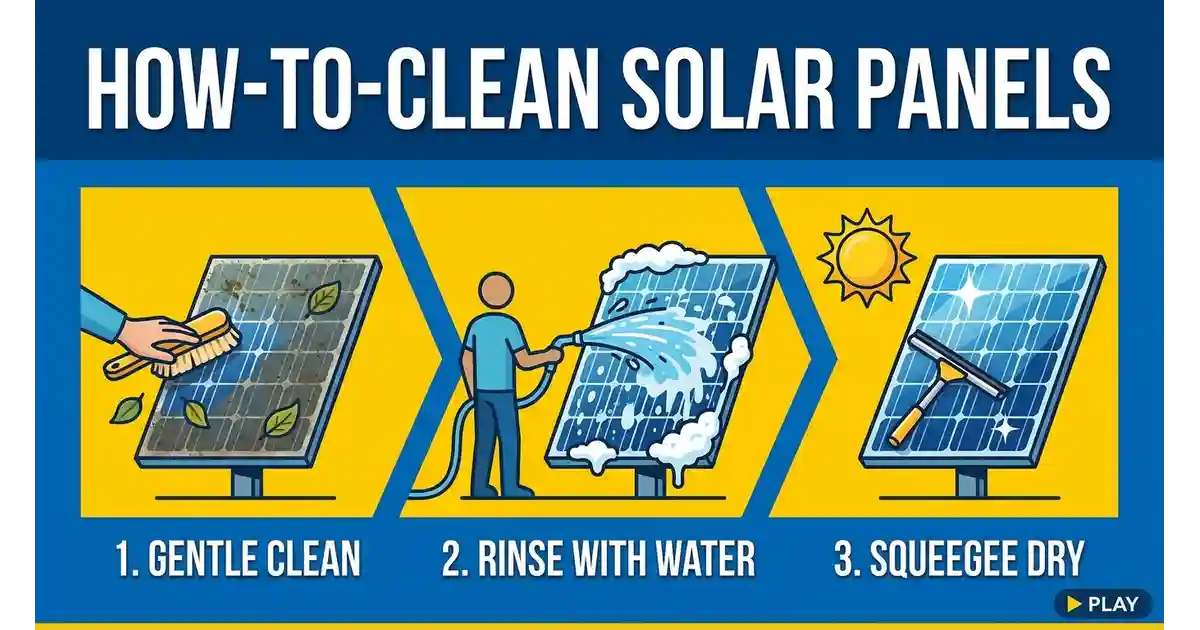
The safest method is: rinse with plain water, scrub gently with a soft brush, wipe in one direction with a squeegee, then rinse again — done in early morning or evening.
- Pick the right time. Clean early morning or evening, never in direct midday sun. Spraying cool water onto hot glass can cause thermal shock and tiny cracks over time.
- Rinse first. Use plain water to loosen and remove loose dust and debris before any scrubbing — this stops grit from scratching the glass.
- Scrub gently. Use a soft brush with soft bristles (not stiff nylon or wire), made for glass or car exteriors, to loosen anything the rinse missed.
- Wipe in one direction. Use a squeegee or microfiber cloth to avoid streaking, especially if you used any cleaning solution.
- Rinse again. A final clean-water rinse removes any leftover residue.
What’s the Best Thing to Clean Your Solar Panels With?
For most routine cleanings, plain water and a soft brush is genuinely the best combination. It’s gentle, effective, and carries zero risk of chemical residue affecting the panel’s glass coating. For tougher spots — dried bird droppings, sap, or hard water mineral deposits — a small amount of mild dish soap diluted in water is generally considered safe for the glass itself, though it’s worth being careful about runoff if you have a garden directly below the panels.
Is Dawn Soap Safe for Solar Panels?
Diluted Dawn dish soap is commonly used by homeowners for spot-cleaning stubborn residue, and it’s generally considered safe for the tempered glass surface in small, diluted amounts. That said, most professional cleaners avoid soap for routine cleaning, since soap residue can attract more dust over time and, if not fully rinsed, can leave streaking that slightly reduces light coming through the glass. If you do use it, dilute heavily and rinse thoroughly with plain water afterward.
Solar Panels Cleaning Solution Options
Plain water works for most routine cleanings; deionized water, diluted soap, or diluted vinegar handle specific problems like hard water spots or stuck-on residue.
Plain Water
The safest option, and enough for most routine cleanings.
Deionized Water
Professional cleaners often prefer this because it’s stripped of minerals, so it doesn’t leave the mineral spotting regular tap water can. Matters most in hard-water areas.
Diluted Mild Dish Soap
Good for tougher residue, but rinse thoroughly to avoid streak buildup.
Diluted White Vinegar
A light vinegar-water mix (roughly one part vinegar to several parts water) can help break down hard water mineral spots. Rinse well afterward.
Commercial Solar Cleaners
Purpose-built solar panel cleaner solutions exist and avoid streaking, but for occasional cleanings, plain water or a light soap dilution gets the same result for far less money.
Cleaning Solar Panels With Hard Water
Hard tap water isn’t a problem itself — the issue is mineral spotting left behind as water evaporates on the glass, not damage from the water itself.
Example: letting hard water air-dry on a panel after rinsing leaves faint white mineral spots within an hour; running a squeegee over the glass right after rinsing removes the water before it evaporates, cutting spotting dramatically for the same cleaning effort.
Solar Panel Cleaning Kits and Equipment
A basic kit includes a soft-bristle brush on an extendable pole, a squeegee attachment, a hose adapter, and optionally a deionized water filter.
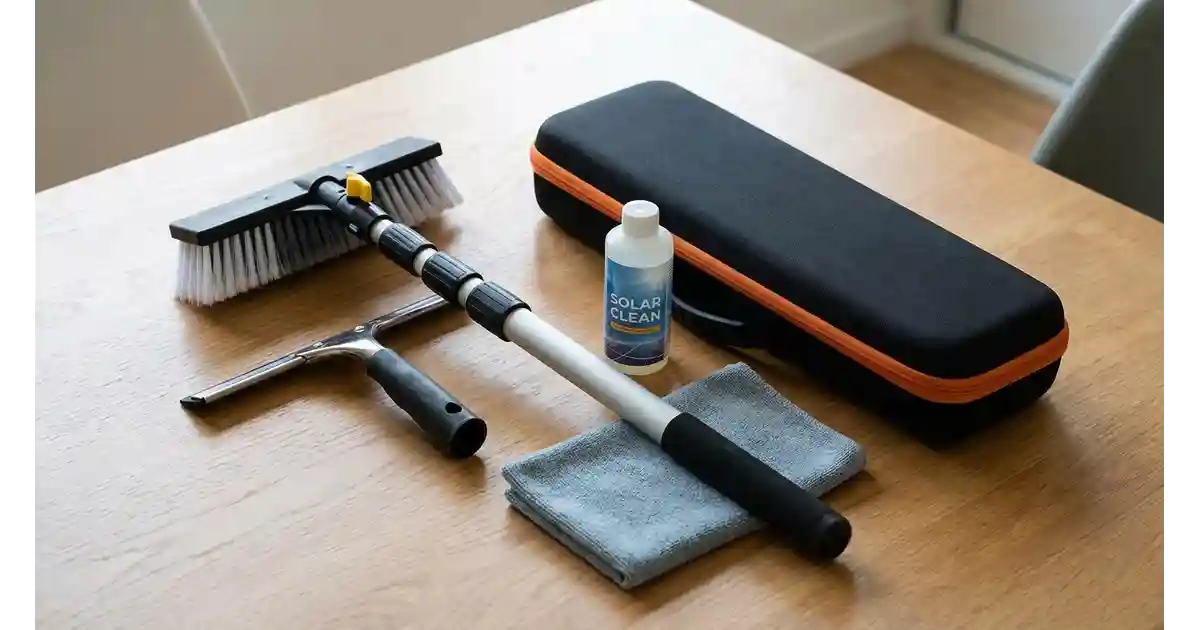
- A soft-bristle brush on an extendable pole, for roof-mounted panels you can safely reach from the ground or a ladder
- A squeegee attachment for the same pole
- A hose adapter for controlled water flow
- Optionally, a deionized water filter attachment that connects to a standard garden hose
For anyone cleaning panels regularly or professionally, professional solar panel cleaning equipment often includes purified water-fed pole systems — a long reach pole combined with an inline deionizing filter, allowing pure water cleaning without soap and without needing a ladder for most residential roof heights.
How to Clean Solar Panels Without Getting on the Roof
Getting on a roof isn’t necessary for most residential cleanings — extendable water-fed poles reach most single-story and many two-story roof pitches safely from the ground.
- Extendable water-fed pole systems let you clean from the ground or a stable ladder position, reaching most standard single-story and many two-story roof pitches.
- Cleaning from the ground with a hose attachment and a soft brush head on an extension pole handles most routine dust and pollen removal without ever stepping onto the roof.
- For steeper roofs, taller homes, or larger arrays, this is where hiring a professional with proper fall-protection equipment becomes the safer, often more cost-effective option.
Robotic and Water-Free Solar Panels Cleaning Systems
Robotic cleaners are automated units that brush dust off panels on a schedule using dry microfiber or brush rollers, with no water needed at all.
These water-free systems are especially useful in:
- Drought-prone regions where water use is restricted or expensive
- Large commercial or utility-scale solar farms where manual cleaning isn’t practical at scale
- Desert climates with frequent dust but limited water access
For a typical residential system, a robotic cleaner is usually overkill given the cost. For larger arrays or water-restricted regions, though, it can pay for itself through steadier output and lower labor cost over time.
How to Clean Snow Off Solar Panels
Use a soft-bristled snow rake, work from the bottom edge up, avoid hot water, and let light snow melt naturally when you can — never use a metal shovel or ice scraper.
- Use a soft-bristled snow rake or roof rake made for solar panels or gutters — never a metal shovel or ice scraper directly on the glass.
- Work from the bottom edge upward where possible, letting gravity help clear loosened snow instead of pushing it against the frame.
- Avoid hot water to melt snow faster. The temperature difference between hot water and frozen glass can crack the panel.
- Let a light dusting melt naturally when you can. Panels at a typical installation angle often shed light snow on their own once the sun comes out.
In many cases, waiting for natural sun-driven melt is safer and just as effective as manual removal, especially for angled rooftop arrays.
How to Clean RV Solar Panels
RV panels follow the same core principles as home systems, but are usually flush-mounted and easy to reach from a step stool or the RV’s own roof access.
- RV panels are usually flush-mounted and easy to reach from a step stool or the RV’s own roof access, so manual cleaning with a soft brush and a bucket of water is usually all you need.
- Deionized water is especially useful for RV owners, since panels get cleaned more often on the road — dust, bugs, and road grime build up faster than on a stationary rooftop.
- A portable spray bottle with a light vinegar-water dilution works well for RVers who want a compact cleaning solution without carrying bulky equipment.
Shopping for panels rather than cleaning tools? See our guide to RV solar panels for sizing and setup.
How to Clean Solar Light Panels (Garden Lights and Outdoor Fixtures)
Small garden and pathway light panels need a damp microfiber cloth, not a brush or hose — they’re too small and delicate for standard cleaning tools.
- Wipe the small panel surface with a damp microfiber cloth. These panels are too small and delicate for a brush or hose.
- Use a small amount of diluted soap for stubborn grime, then wipe dry right away.
- Check for cloudy or hazy buildup on the plastic lens covering many garden light panels. This is often UV wear or a film, not dirt, and can sometimes improve with a plastic polish made for outdoor lenses — though heavily clouded lenses from UV damage may need replacing rather than cleaning.
- Clean garden and pathway light panels every 1–2 months during the growing season, since they sit low to the ground and collect dirt, grass clippings, and pollen faster than a rooftop array.
How Much Does Solar Panel Cleaning Cost?
Professional cleaning runs $150–$500 per residential visit or $5–$20 per panel; DIY tools cost $50–$250 as a one-time purchase.
| Cleaning Method | Typical Cost | Best For |
|---|---|---|
| DIY (one-time equipment) | $50–$250 | Ground-level access, comfortable doing it yourself |
| Professional, one-time visit | $150–$500 | Steep or high roofs, first-time deep clean |
| Professional, per panel | $5–$20 per panel | Larger systems billed by panel count |
| Annual or bi-annual service plan | Lower per-visit cost than one-time | Homeowners who want scheduled upkeep without remembering it |
Regional note: Hot, dry, dusty states (Arizona, Nevada, parts of California) tend to sit at the higher end of the price range, since hard tap water often requires deionized water systems, and drought conditions mean panels go longer without a natural rinse from rain. Rainier regions typically need cleaning less often, which can lower the total yearly cost even if a single visit costs about the same.
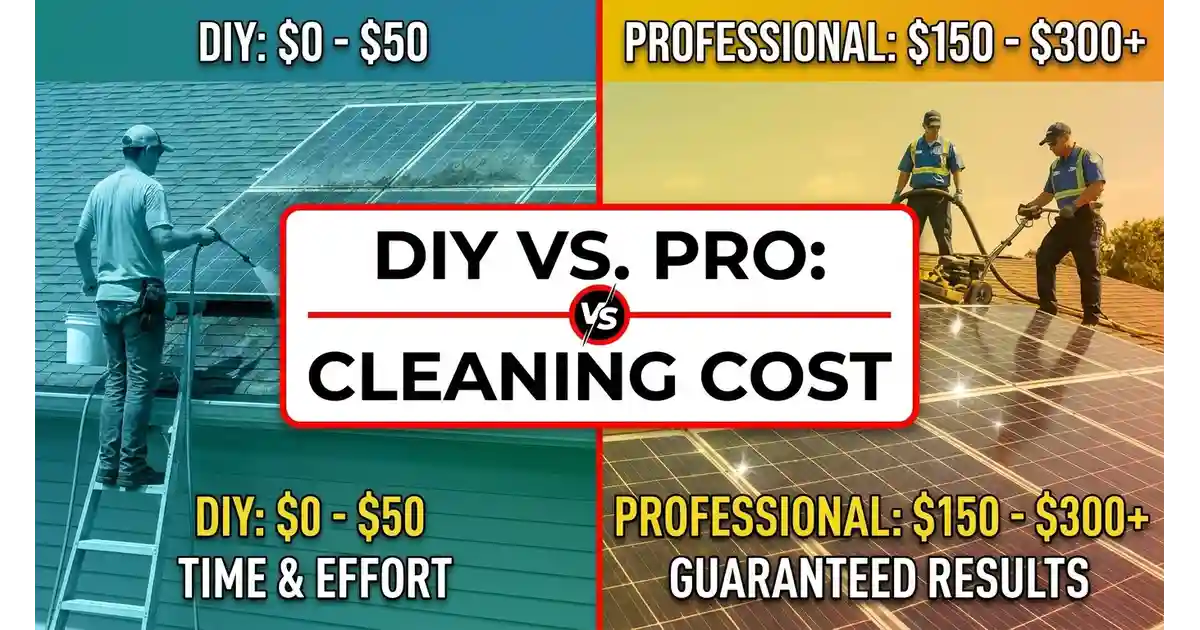
DIY cleaning with a basic water-fed pole kit costs a one-time investment of roughly $50–$150, making it the more economical route for homeowners comfortable doing it themselves once or twice a year. For the broader cost of going solar in the first place, see what it typically costs to install solar panels.
DIY vs Professional Solar Panel Cleaning Compared
DIY cleaning is cheaper and fine for ground-level, single-story systems; a professional solar panel cleaning service is safer and more thorough for steep roofs, large arrays, or warranty-sensitive equipment.
| Factor | DIY Cleaning | Professional Cleaning Service |
|---|---|---|
| Upfront cost | $50–$250 one-time tools | $150–$500 per visit |
| Water quality used | Usually tap water — can leave spots | Often deionized water — spot-free rinse |
| Inspection included | No — visual only, untrained eye | Yes — hardware and hot-spot check |
| Safety risk | Roof-access falls if climbing up | Trained technicians, insured for roof work |
| Warranty risk | Higher if wrong tools or pressure used | Low — manufacturer-approved methods |
| Best for | Ground-level, single-story, low-risk roofs | Steep, high, or warranty-sensitive systems |
Does DIY Cleaning Void Your Warranty?
It can, in some cases. Most manufacturers allow gentle water-and-soft-brush cleaning without issue, but abrasive tools, high-pressure water, or harsh chemicals can void coverage.
Example: using a household pressure washer on the “high” setting can force water past a panel’s seals or damage the anti-reflective coating — either of which a manufacturer can point to when denying a warranty claim, even if the crack or fault shows up months later.
Before you clean for the first time: check your panel manufacturer’s specific care instructions, usually in your installation paperwork or on the manufacturer’s website. This takes a few minutes and can save you from an expensive mistake.
Frequently Asked Questions
What’s the best thing to clean your solar panels with?
Is Dawn soap safe for solar panels?
Do I need to turn off solar panels before cleaning?
What is the best way to clean RV solar panels?
How often should solar panels be cleaned?
Can I pressure wash solar panels?
Does rain clean solar panels?
How much does solar panel cleaning cost?
Can dirty solar panels cause damage?
When to Call a Professional Solar Panel Cleaning Service
DIY cleaning covers most situations, but a professional solar panel cleaning service is worth it for steep roofs, large arrays, scheduled upkeep, or heavy caked-on residue.
- Your roof pitch or height makes safe ground-level or pole-based cleaning impractical
- You have a large commercial array where manual cleaning isn’t time- or cost-effective
- You want a scheduled seasonal service rather than remembering to do it yourself
- You’re dealing with heavy, caked-on residue, like extended bird droppings or industrial dust, that basic tools aren’t cutting through
Keeping panels clean is one of the simplest ways to protect your system’s actual output relative to what you paid for it. A small amount of routine maintenance genuinely adds up over a 25-year system lifespan. For the bigger picture on long-term upkeep, see our full solar panel maintenance guide, or find a solar installer near you if it’s time for a full system check.
This guide is for general information. Always check your specific panel manufacturer’s cleaning instructions before your first DIY clean, and consult a licensed installer for anything involving roof access or electrical components.