RV Solar Panels: The Complete 2026 Buying Guide
How many watts you really need, honest 2026 pricing, DIY vs. professional cost, and the truth about running your AC off solar.
RV solar panels are photovoltaic panels mounted on or carried inside a recreational vehicle that convert sunlight into DC electricity, which a charge controller stores in a battery bank for lights, appliances, and electronics away from shore power. They work on the same core principle as home solar panels, just scaled down for mobile use.
01. How Do RV Solar Panels Work?
Solar panels for RV use work by capturing sunlight on the roof (or on a portable panel) and converting it into DC electricity, which a charge controller feeds into a battery for later use. Skip any part of that chain and the system stops working.
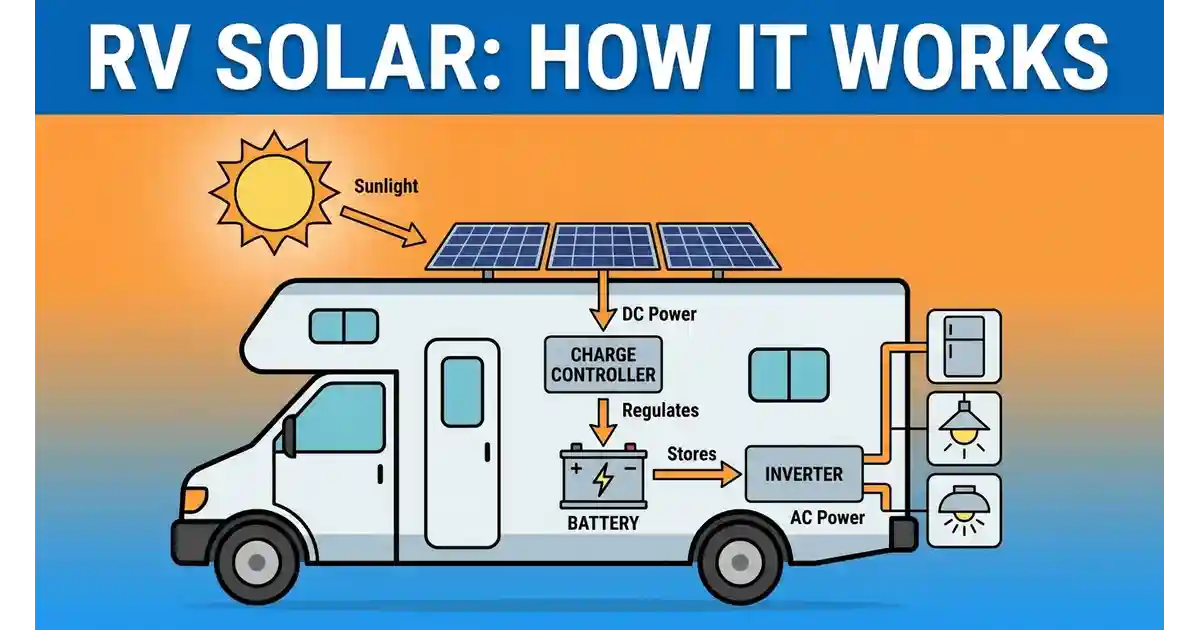
RV solar panels and solar panels for RV setups work the same simple way. Panels on your roof, or unfolded on the ground, catch sunlight and turn it into electricity. That power flows through a charge controller into your battery. From there, it runs your lights, fan, water pump, and phone chargers. For the underlying science, see our guide to how solar panels work.
Here is the short version of every part in the chain:
- Solar panel — catches sunlight, makes DC power.
- Charge controller — the traffic cop. It stops your battery from overcharging. The U.S. Department of Energy’s guide to solar electric system design covers how controllers regulate this flow in more detail.
- Battery — stores power for use at night or on cloudy days.
- Inverter — turns battery power (DC) into regular wall-outlet power (AC) for things like a coffee maker or laptop charger.
Skip any one part and the system does not work. This is why a bare panel with no controller or battery is really only half a system.
02. Solar Panels for RV Campers, Vans & Pop-Ups
Not much. Solar panels for RV campers, camper vans, and pop-ups all describe the same core setup — panel, controller, battery, inverter. The real difference is roof shape and available space, not the electricity itself.
Camper vans (Sprinter, Transit, ProMaster conversions) usually have curved, low-profile roofs. Flexible panels bend to match the curve and add very little height. Rigid panels give better long-term output but need mounting feet, which raise the roofline a couple of inches.
A pop-up camper solar panel setup has its own quirk: the roof folds down when you are driving. That rules out permanently wired rooftop panels unless you run disconnect cables every time you set up camp. Because of this, many people search “pop up camper with solar panels” and land on a portable “suitcase” panel instead — no wiring through a folding roof required.
Portable Solar Panels for RV: When a Suitcase Kit Makes More Sense
Portable solar panels for RV owners are the simplest fix for a folding roof, a rented rig, or anyone who doesn’t want to drill into the roof at all. You set the panel up on arrival, angle it toward the sun, and pack it away before driving off — the trade-off is that it only works while you’re parked and watching it. If you want a deeper breakdown of portable options and specs, see our portable solar panels guide.
| Setup type | Best for | Trade-off |
|---|---|---|
| Portable “suitcase” panel (100–200W) | No permanent roof drilling needed | Have to set up and put away every stop |
| Roof-mounted flexible panel with quick-disconnect | Hands-free once installed | Requires running a sealed cable through the fold point |
| Ground panel + long cable | Cheapest, most flexible for chasing sun | Not weatherproofed to leave out unattended |
03. Types of RV Solar Panels
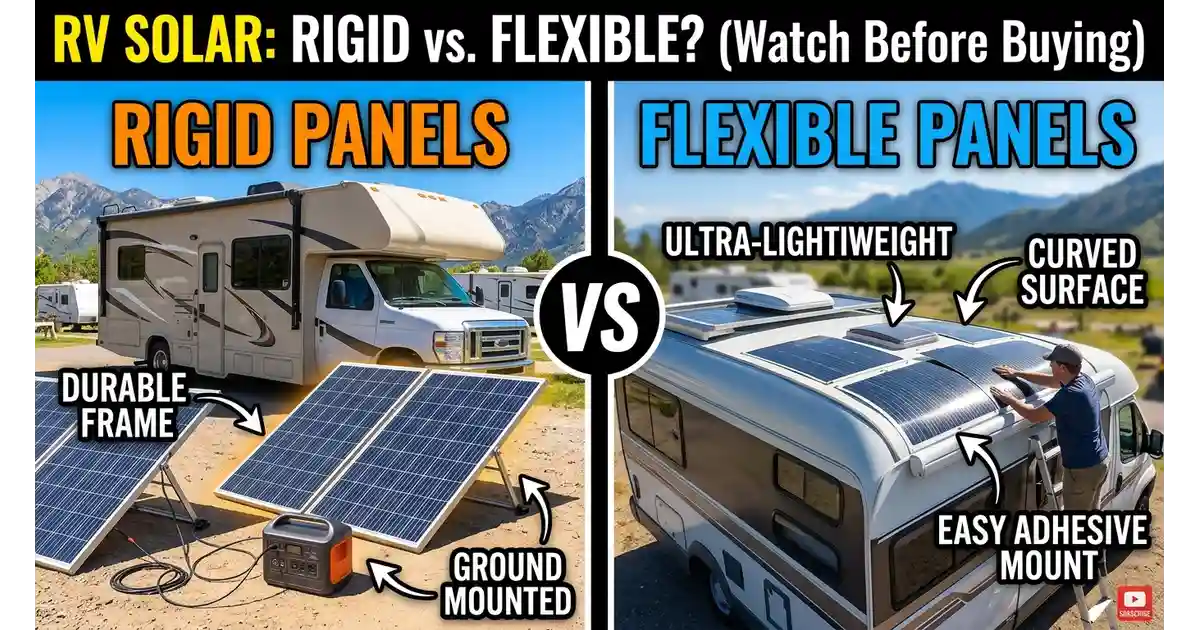
RV solar panels come in three main types: rigid, flexible, and portable. The right option depends on your roof space, weight limits, installation preference, and how often you move your panels.
| Type | Best for | Main advantage | Main drawback |
|---|---|---|---|
| Rigid | Permanent RV roof systems | Durable and long-lasting | Heavier and more visible |
| Flexible | Some curved or low-profile roofs | Lightweight and low profile | Can run hotter and may have a shorter service life |
| Portable | Pop-ups, rentals, and temporary setups | Easy to move and angle toward the sun | Requires setup when camping |
For most permanent RV installations, rigid monocrystalline panels are a practical starting point. Portable panels make more sense when roof mounting is not possible or when you want to move the panel to chase sunlight.
04. How Many Watts of Solar Do You Need for an RV?
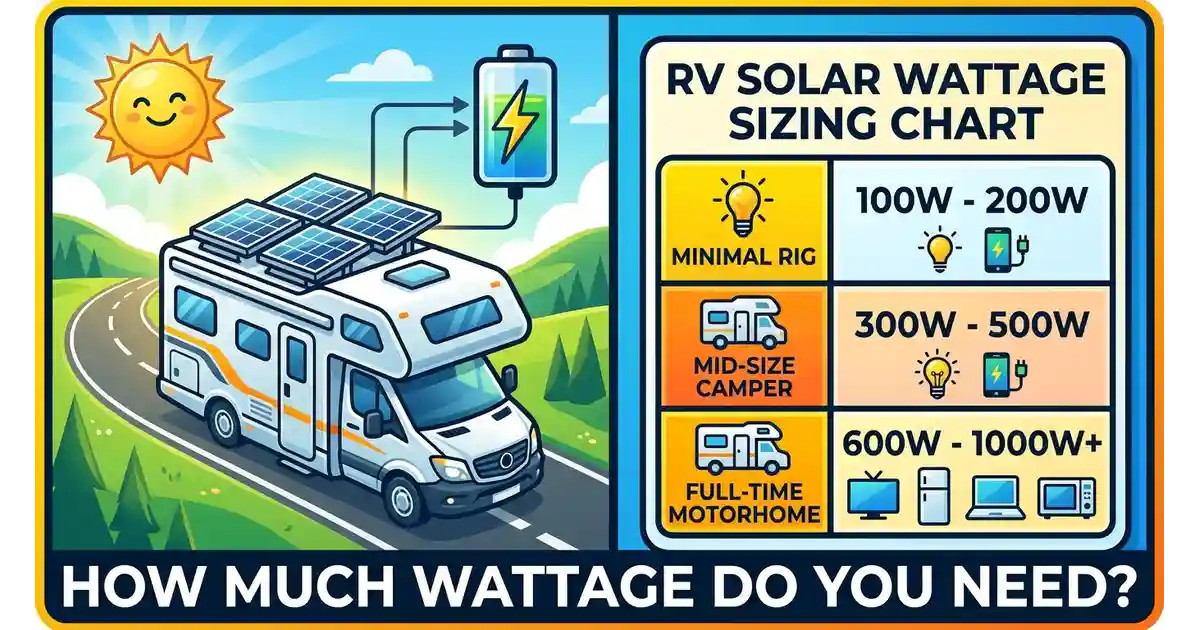
Size an RV solar system around your daily electricity use, available sunlight, roof space, and battery capacity. A common starting point is to size solar production above your average daily use so the system can recover from less-than-ideal weather, but the exact amount depends on your location and camping habits.
This is the question that matters most, and it is where most guides get vague. The real math: figure out your daily watt-hour use, then size your panels with some buffer above that number to help cover cloudy days. Our solar panel calculator can help you run these numbers against your own appliance list.
A rough planning estimate is that 100 watts of solar may produce a few hundred watt-hours per day under favorable conditions. Actual output varies with location, season, shading, panel angle, temperature, and system losses.
| System size | Daily output (typical) | Good for | Battery pairing |
|---|---|---|---|
| 200 watts | 600–1,000 Wh/day | Weekend trips, lights, phones, water pump — see our small solar panels guide | 100Ah lead-acid or 100Ah lithium |
| 400 watts | 1,200–2,000 Wh/day | Small fridge, TV, laptop, occasional microwave | 200–300Ah lithium |
| 1,000 watts | 3,000–5,000 Wh/day | Full-time boondocking, CPAP, multiple devices, partial AC support | 400Ah+ lithium |
How Many Solar Panels Do You Need for an RV?
The number of RV solar panels depends on the wattage of each panel and how much electricity you use. For example, a 400-watt system could use four 100-watt panels, two 200-watt panels, or one 400-watt panel.
As a simple starting point:
- 200W: 2 × 100W panels or 1 × 200W panel
- 400W: 4 × 100W panels or 2 × 200W panels
- 600W: 3 × 200W panels
- 800W: 4 × 200W panels or 2 × 400W panels
- 1,000W: 5 × 200W panels or a combination that totals about 1,000 watts
The best choice depends on your RV roof space, panel size, shading, battery capacity, and daily electricity use. More panels are not automatically better if your roof cannot accommodate them or your charge controller and battery are undersized.
05. What Can RV Solar Panels Run?
A 200W system covers lights and phone charging; 400W adds a fridge, TV, and laptop; and 800W or more supports heavier boondocking loads. Running an air conditioner is the exception — it usually requires a much larger dedicated system.
| RV solar system | Typical uses |
|---|---|
| 100W | Phones, lights, battery maintenance |
| 200W | Lights, phones, fan, water pump |
| 400W | Fridge, TV, laptop, lights |
| 600W | Fridge, TV, microwave occasionally |
| 800W–1,200W | Heavy boondocking, multiple appliances |
| 1,200W+ | Larger loads with substantial battery storage |
| Air conditioner | Usually requires a much larger dedicated system — see below |
06. Can RV Solar Panels Run an Air Conditioner? What It Really Takes
RV solar can run an air conditioner, but AC is one of the hardest RV loads to support from solar. The required solar array, battery bank, and inverter depend on the AC unit’s running power, starting surge, hours of use, weather, and how much other electricity the RV uses.
This is one of the most overhyped claims in RV solar marketing, so let’s be blunt about the scale involved.
A typical RV air conditioner needs about 1,200 to 1,800 running watts and 1,800 to 3,500 surge watts just to start. That single appliance uses more power in one hour than most RVs’ basic electronics use in a full day.
To run one AC unit for around 8 hours, you’re generally looking at something in this range:
- 1,000 to 1,800 watts of solar panels (not 200 or 400)
- 400 to 600Ah of lithium battery
- A pure sine wave inverter rated at least 3,500 watts continuous, with surge capacity above 4,000 watts
- An MPPT charge controller — PWM controllers are too inefficient for this load
Even then, most full-timers who run AC off-grid treat solar as a top-up, not the main source. They lean on a generator during the hottest stretch of the day and let solar recover the battery overnight and in the morning. A “soft start” device on the AC compressor can cut starting wattage by 50% or more, which makes a smaller inverter workable — that upgrade is often cheaper than doubling your solar array.
Bottom line on this one: if a product page tells you a basic 400-watt kit will run your RV’s air conditioner all day, that claim does not hold up. Budget for a much bigger, dedicated system if AC is the goal.
07. RV Solar Panel Kits: What’s Actually in the Box
An RV solar panel kit bundles the panel, mounting brackets, cables, and a charge controller — but most basic kits leave out the battery and inverter, which you’ll need to buy separately unless you choose a complete kit.
An RV solar panel kit is the same idea as a camper solar panel kit — the labels are interchangeable in the market. A basic kit usually includes: one or more monocrystalline panels, an MPPT or PWM charge controller, mounting brackets (often called Z-brackets), and MC4 connector cables. For a broader look at kit options beyond RVs, see our solar panel kit guide.
RV Solar Panel Kit With Battery and Inverter: The Complete Option
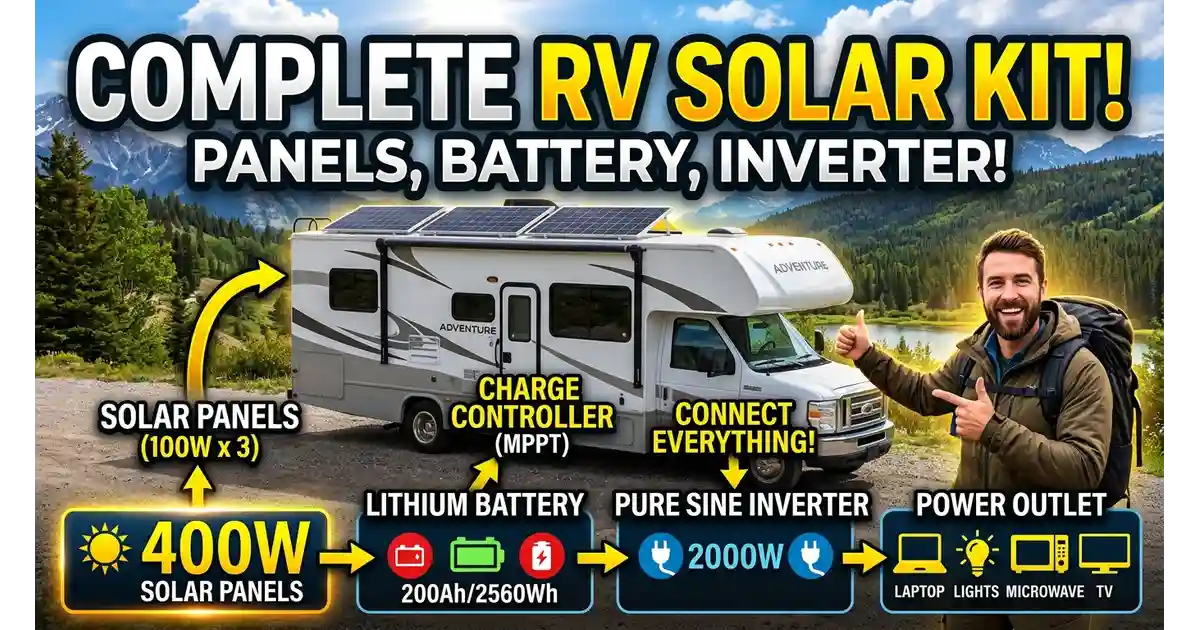
An RV solar panel kit with battery and inverter goes a step further and adds the two components most basic kits leave out — the parts you need to actually store and use the power for household-style outlets. These complete kits cost more upfront but save you from mismatched, incompatible parts, which is a common and expensive mistake in DIY builds.
| Kit type | Typical price range | What’s missing (if anything) |
|---|---|---|
| Panel + controller only (200–400W) | $180–$450 | Battery, inverter |
| Panel + controller + mounting (400W) | $350–$650 | Battery, inverter |
| Complete kit with battery + inverter (400–800W) | $1,200–$2,800 | Nothing — ready to wire in |
| Complete off-grid kit (1,000W+, lithium battery) | $3,000–$6,000+ | Nothing, built for full-time use |
Charge controllers matter more than most buyers expect. A PWM controller is cheaper but wastes some of the power your panels generate. An MPPT controller costs more but squeezes noticeably more usable power out of the same panels — usually a meaningful percentage more, and it’s the better choice for any system over 300 watts.
08. Best Solar Panels for RVs in 2026: What to Look For
The best solar panels for an RV depend on roof space, power needs, weight, and budget. Rigid monocrystalline panels are usually a strong fit for permanent roof installations, flexible panels work well on some curved roofs, and portable panels are useful when you do not want a permanent installation.
Based on 2026 pricing across major retailers, here are common examples by category — treat these as a starting point for your own research rather than a definitive ranking.
| Category | Example |
|---|---|
| 200W rigid panel | Renogy 200W |
| Budget option | Rich Solar / ECO-WORTHY |
| Premium rigid panel | Victron BlueSolar |
| 400W kit | Renogy 400W kit |
| Portable option | Renogy / EcoFlow |
| Flexible option | Anker SOLIX / flexible mono |
For context: monocrystalline panels run 19–22% efficient and hold up 20–25 years. Polycrystalline panels are cheaper but sit at 15–17% efficiency and take up more roof space for the same output — most 2026 buyers skip poly entirely for RV use because roof space is tight. See our full solar panel types comparison for how these technologies stack up outside the RV context.
What to Look for in an RV Solar Panel
- Wattage: Match the panel size to your daily electricity needs and available roof space.
- Efficiency: Higher efficiency can help when roof space is limited.
- Panel type: Choose rigid, flexible, or portable based on your RV and installation needs.
- Weight: Check the RV roof and cargo limits before adding a large array.
- Warranty: Compare product and performance warranties before buying.
- Connector compatibility: Make sure the panel works with your charge controller and existing wiring.
09. RV Solar Panel Cost: DIY vs. Professional Installation
DIY installation typically costs 30–50% less than hiring a pro, but professional installs include labor, a workmanship warranty, and correctly sized wiring from the start.
RV solar panel cost depends on the panel wattage, battery capacity, charge controller, inverter, mounting hardware, wiring, and installation labor. A small system can cost a few hundred dollars, while a large off-grid setup with lithium batteries can cost several thousand dollars.
| System size | DIY cost | Professionally installed |
|---|---|---|
| 100–200W (lights, charging) | $300–$600 | $500–$900 |
| 300–400W (fridge, laptops) | $700–$1,200 | $1,000–$1,800 |
| 500–800W (microwaves, TVs) | $1,300–$2,500 | $2,000–$3,500 |
| 1,000W+ (AC, heavy use) | $3,000–$6,000 | $4,500–$8,000+ |
Professional installs typically cost 30–50% more than DIY, but that premium usually includes labor ($1,500–$3,000 for a full system at $100–$150 an hour), a workmanship warranty, and correctly sized wiring the first time. DIY saves money if you already own basic tools (multimeter, wire strippers, crimpers) and are comfortable following a wiring diagram exactly. For the equivalent home-rooftop process and pricing, see our solar panel installation guide and solar installation cost breakdown. If you’d rather hire a pro, compare local options through our solar installers near me directory.
10. Lithium vs. Lead-Acid Batteries for RV Solar
Lithium (LiFePO4) batteries usually cost more upfront than lead-acid batteries but provide more usable capacity and longer cycle life. They can be a good fit for frequent boondocking, while lead-acid batteries can still make sense when the lowest upfront cost is the priority.
Panels are only half the system. The battery decides how much of that power you can actually store and use.
| Battery type | Usable capacity | Typical lifespan | Relative cost |
|---|---|---|---|
| Lead-acid / AGM | ~50% of rated capacity | 3–5 years | Lowest upfront cost |
| Lithium (LiFePO4) | ~80–100% of rated capacity | 10–15 years | Roughly 2x lead-acid, but far lower cost per usable cycle |
Lithium batteries cost more upfront but deliver roughly double the usable capacity and 5–10 times the lifespan of lead-acid. In a properly sized system, the battery bank typically represents 35–55% of total component cost — it is usually the single biggest line item, not the panels.
How Much Battery Capacity Do You Need for RV Solar?
A common starting point is about 100Ah of lithium battery capacity for each 200–300 watts of solar, but your actual battery size should be based on daily energy use. A 400W solar setup may pair well with a 200Ah lithium battery for moderate RV use, while heavy boondocking can require 300–400Ah or more.
Solar panels determine how quickly you can recharge. Battery capacity determines how much electricity you can store for nighttime and cloudy periods.
11. How to Install Solar Panels on an RV
Setting up solar panels for RV use comes down to five steps: calculate daily watt-hours, size the panels, choose a mounting style, run properly gauged wiring, then connect the controller to the battery before the panels.
This isn’t a full install manual, but it covers what to plan for before you start.
Should You Install RV Solar Panels Yourself?
Yes, a basic RV solar panel setup can be a DIY project if you understand DC wiring and follow the equipment manufacturer’s instructions. However, larger systems involving lithium batteries, high-current wiring, an inverter, or the RV breaker panel carry greater electrical risk. If you are unsure about wire sizing, fuses, grounding, or battery connections, have an RV technician inspect the installation.
A basic 400-watt roof kit takes a reasonably handy person a weekend to install. Anything involving a new battery bank, inverter wiring, or breaker panel work is worth having a mobile RV technician check, even if you do the physical mounting yourself.
12. RV Solar Panel Lifespan: What Wears Out First
Batteries and inverters wear out long before the panels do. Rigid panels last 20–25 years; lithium batteries and inverters typically need replacing within 10–15 years.
Knowing which part fails first helps you budget for replacements, not just the initial purchase.
| Component | Typical lifespan |
|---|---|
| Rigid monocrystalline panels | 20–25 years, gradual output decline (~0.5%/year) |
| Flexible / portable panels | 5–10 years with regular use |
| LiFePO4 lithium batteries | 10–15 years at normal cycling rates |
| Lead-acid / AGM batteries | 3–5 years |
| MPPT charge controllers & inverters | 5–10 years |
The panels almost never fail first — batteries and inverters are the components you will actually replace during the system’s lifetime. Budget for that when comparing sticker prices. Routine solar panel maintenance also helps you catch a failing component before it takes the whole system down.
13. Is RV Solar Worth It?
RV solar can be financially worthwhile for frequent boondockers because it can reduce generator fuel use and campground hookup dependence. The payback period varies widely based on system cost and how often you camp without shore power.
If you almost always camp at full-hookup sites, the case for a large system is weaker, since you are not avoiding much hookup cost. In that case, a smaller system for backup power and boondocking flexibility may make more sense than a large, expensive array.
14. Does RV Solar Qualify for the Federal Tax Credit in 2026?
New RV solar installs in 2026 do not qualify for the 30% federal tax credit. The Residential Clean Energy Credit ended for systems placed in service after December 31, 2025.
A lot of older solar content still advertises a 30% federal tax credit for RV solar installs. That is now outdated information for 2026.
The IRS Residential Clean Energy Credit guidance (Section 25D) confirms the credit ended for any system placed in service after December 31, 2025, under the One Big Beautiful Bill Act. If you installed solar before that date, you can still claim it on your 2025 tax return, and unused credit amounts can carry forward. But a system bought and installed new in 2026 does not qualify for this federal credit. This is a time-sensitive tax matter, so verify current IRS guidance directly or consult a tax professional rather than relying solely on this summary.
15. Real Trade-Offs Nobody Puts in the “Benefits” List
Panels are only half the system, real-world output runs below the sticker rating, and DIY wiring mistakes can cost more than the panels themselves. Here’s what most RV solar pages leave out.
Every RV solar page loves to list the upsides. Here’s what they usually leave out.
- Panels are only half the system. A big panel array with a small or aging battery bank won’t give you more usable power — the battery is the actual bottleneck for most rigs.
- Real-world output runs 10–20% below the sticker rating most of the time, due to heat, dust, and angle.
- Flexible panels typically don’t last as long as rigid ones. They run hotter against the roof, which speeds up degradation. Many are warrantied for fewer years than rigid monocrystalline panels.
- Cloudy stretches can wipe out days of planning. A system sized for sunny climates can leave you short in the Pacific Northwest or during a rainy week anywhere.
- DIY wiring mistakes are common and can be costly. Undersized wire, reversed polarity, or a mismatched controller can damage a battery bank worth more than the panels themselves.
- Weight adds up. A 1,000-watt rigid array plus a large lithium battery bank can add several hundred pounds — worth checking against your RV’s cargo weight rating before you buy.
Frequently Asked Questions
Do RV solar panels charge while driving?
Yes, as long as the panels are wired into your battery system through a working charge controller. Movement doesn’t affect charging — only sunlight exposure does, so a shaded travel route produces less power than midday parking in the sun.
How many solar panels do I need for an RV?
This depends on the wattage of each panel and your daily electricity use. A 400-watt system, for example, could use four 100-watt panels, two 200-watt panels, or one 400-watt panel — the total wattage matters more than the panel count.
How many watts of solar do I need for an RV?
Size an RV solar system around your daily electricity use, available sunlight, roof space, and battery capacity. Most RVers do well with 200 to 600 watts for lights, phones, and basic electronics, while full-time boondockers often need 800 to 1,200 watts or more.
Can RV solar panels run a refrigerator?
Yes, a typical 12V RV fridge or small residential fridge can run on a 400-watt solar setup paired with a lithium battery in the 200–300Ah range, provided there’s enough daily sun to keep the battery topped up.
Can RV solar panels run an air conditioner?
RV solar can run an air conditioner, but AC is one of the hardest RV loads to support from solar. It generally requires a much larger solar array, a sizable lithium battery bank, and a high-capacity inverter, with a generator often used as backup during peak heat.
Do I need a battery for RV solar panels?
Yes. Without a battery, your panels can only power devices in direct real-time sunlight — nothing at night, and output drops any time a cloud passes over.
How much do RV solar panels cost?
A basic 200-watt DIY system runs about $300–$900 including a controller and small battery. A full off-grid system with 800–1,200 watts and a lithium battery bank, professionally installed, can run $8,000–$12,000 or more.
How long do RV solar panels last?
Rigid monocrystalline panels are commonly rated for 20–25 years, often with a 25-year production warranty. Flexible and portable panels tend to have shorter practical lifespans, often in the 5–10 year range with regular use.
Bottom Line on Solar Panels for RV Campers
Most RVers don’t need the biggest system on the shelf — they need the right-sized one. A 200-watt setup handles occasional weekend trips. A 400-watt kit covers a fridge, TV, and daily basics for most travelers. Full-time boondockers, especially anyone chasing air conditioning off-grid, should plan for 800 to 1,200-plus watts paired with a serious lithium battery bank, and a generator as backup for the hottest days. Skip the tax-credit hype for new 2026 installs, size around your actual daily watt-hours, and buy the battery and inverter to match your panels, not just the panels alone.