
Written by Munir Ahmed · Updated August 2026
Solar batteries store extra electricity your panels produce during the day so you can use it after sunset, during a power outage, or when grid electricity costs more. Most U.S. homeowners don’t strictly need battery storage to benefit from solar panels. But if you face frequent outages, time-of-use electricity rates, or low payouts for excess solar power, adding a battery can make your entire system far more valuable.
Before comparing brands and specs, start with two simple questions:
Do you actually need one? And how much storage capacity does your home require?
This guide walks through what solar batteries are, how they work, the different types available, sizing, real 2026 pricing, lifespan, safety, and whether they’re worth the investment this year.
What Are Solar Batteries?
Solar batteries are rechargeable energy storage units that work alongside a solar panel system. They store extra electricity your panels generate whenever your home isn’t using all of it.
Without one, surplus solar electricity usually flows back to the utility grid. Your home then draws power from the grid when your panels aren’t producing, depending on your utility’s rules.
With a home battery installed, you can store that extra power and use it later instead of sending it away.
Here’s how the system typically functions:
- During the day: Panels generate electricity → your home uses some → the battery stores the surplus.
- At night: Panels stop producing → your home draws on stored power.
- During an outage: The battery can power selected circuits or the whole home, depending on the system design.
Battery storage also helps homeowners use more of their own solar electricity instead of buying it back from the grid later at a higher price.
How Do Solar Batteries Work?
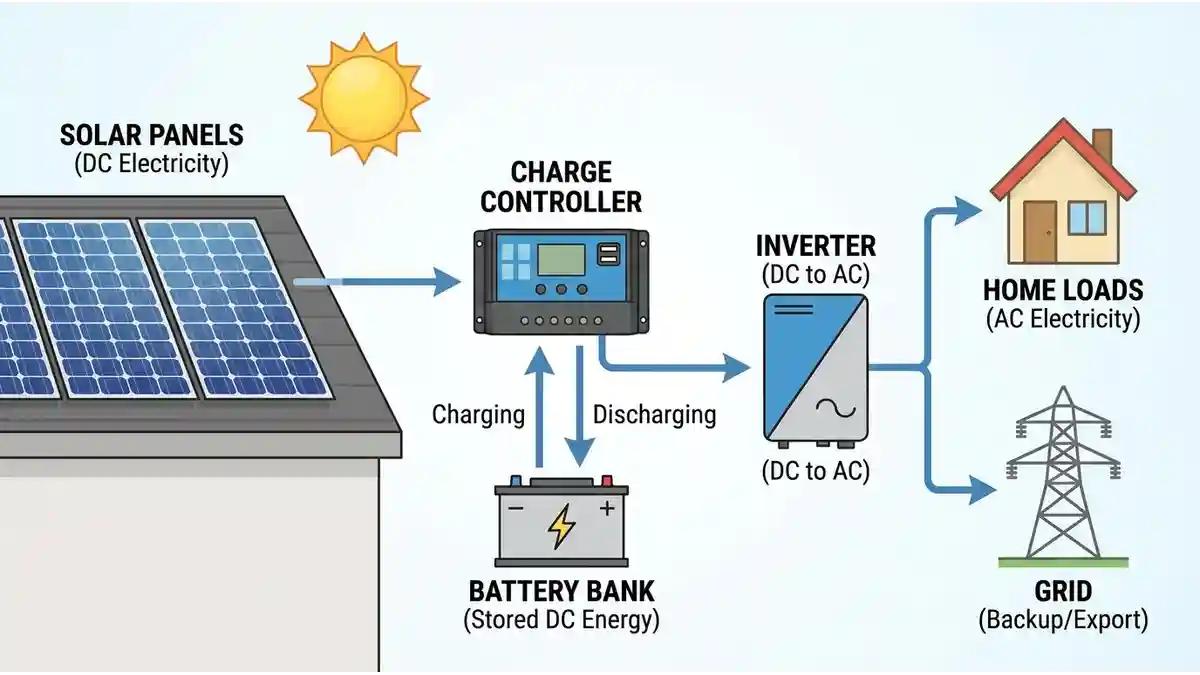
Solar panels generate DC electricity during daylight hours. An inverter converts this into AC electricity, the form most home appliances use.
Some of that solar power goes directly to your home. Any surplus can charge your solar batteries.
Later, solar batteries send stored electricity back through an inverter so your home can draw on it.
The basic flow looks like this:
Solar panels → inverter → home → solar batteries → home
The system manages this automatically, deciding in real time whether your home should run on solar power, battery power, or grid power.
During a blackout, a properly installed battery system can disconnect your home from the grid and continue supplying power — something standard grid-tied solar panels can’t do on their own, since they normally shut off when the grid fails for safety reasons.
For more background, see our how solar panels work guide.
Do You Need Solar Batteries With Solar Panels?
No — solar panels work perfectly well without solar batteries.
Whether adding storage is worth it depends on your electricity rates, utility rules, outage risk, and personal goals.
A battery may be worth it if:
- Your area has frequent power outages — backup keeps essential loads running.
- Your utility uses time-of-use rates — store cheap daytime solar power and use it during expensive evening hours.
- Your utility pays little for excess solar exports — storing that power yourself can be more valuable than sending it to the grid.
- You want quiet, automatic backup power — without gasoline or propane.
- You want more control over your own solar electricity rather than exporting it for a low credit.
If your utility still offers strong net metering and outages are rare, the financial case is weaker.
See our Are Solar Panels Worth It? guide for the bigger picture on solar investment.
Main Types of Solar Batteries
Home energy storage generally falls into one of three categories:
- Lithium iron phosphate (LFP)
- Lead-acid
- Flow batteries
Lithium Iron Phosphate (LFP)
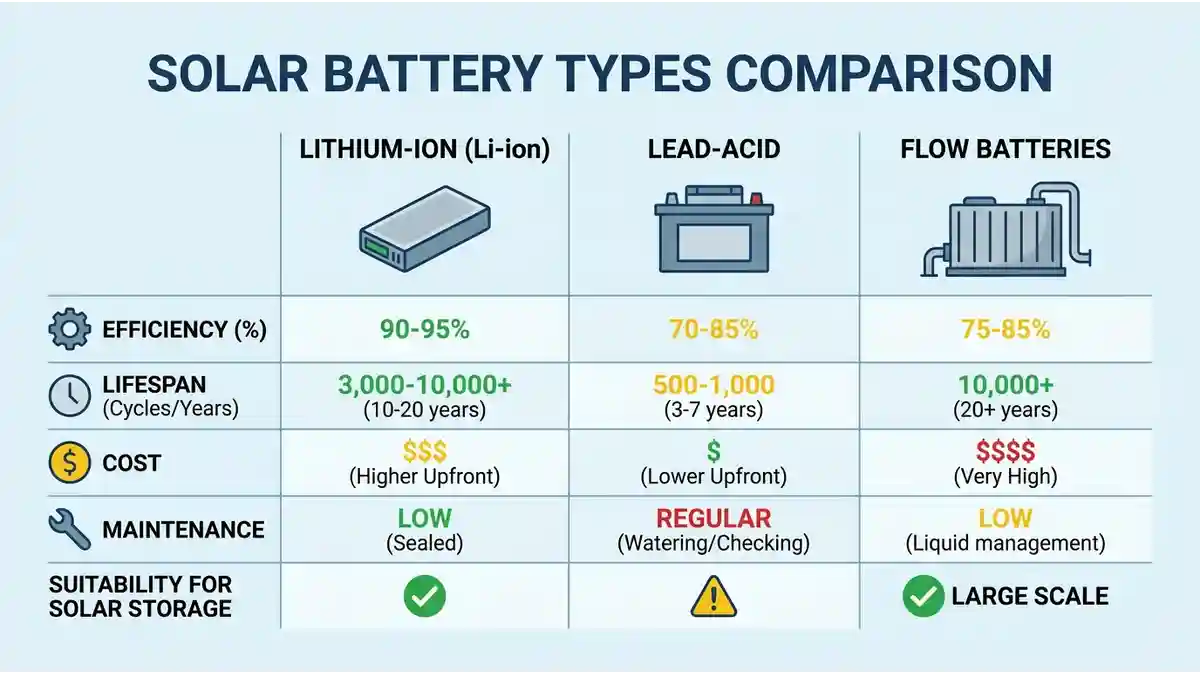
LFP is the most common chemistry used in modern residential storage. It offers long cycle life, strong thermal stability, and high usable capacity — which is why most current systems rely on it.
LFP units cost more upfront than lead-acid options but typically last far longer under daily cycling.
Lead-Acid
Lead-acid is an older, cheaper technology. These units cost less initially but usually wear out faster when cycled daily. They’re still common in off-grid cabins, RVs, and low-budget backup setups.
See where this fits in our RV solar panels and portable solar panels guides.
Flow Batteries
Flow batteries use liquid electrolytes and offer long service life, making them interesting for large-scale storage projects. They’re generally too bulky and expensive for typical residential use.
For most homeowners shopping for solar batteries in 2026, LFP is the chemistry to prioritize.
Lithium vs. Lead-Acid Solar Batteries: Which Is Better?
For most home solar systems, lithium is the better long-term choice.
| Feature | LFP Lithium | Lead-Acid |
|---|---|---|
| Typical life | 10–15 years | 3–7 years |
| Cycle life | Thousands of cycles | Much lower |
| Usable capacity | Generally high | Generally lower |
| Upfront cost | Higher | Lower |
| Daily solar cycling | Excellent fit | Less suitable |
| Common use | Home energy storage | Off-grid, RV, backup |
Real-world performance depends on the model, temperature, depth of discharge, and warranty terms. Over time, replacing multiple lead-acid units can erase their initial price advantage — making lithium the smarter pick for most grid-connected homes.
How Much Solar Battery Storage Does a Home Need?
Sizing correctly depends on what you want to power and for how long. Start with your utility bill to understand your household’s energy use.
5–10 kWh: Basic Backup
Enough for essentials like:
- Refrigerator
- Lights
- Wi-Fi
- Phones and small electronics
10–20 kWh: Essential-Load Backup
Covers more, including:
- Refrigerator, lights, Wi-Fi
- Well pump
- Microwave
- Some heating or cooling
- Medical equipment
20–40+ kWh: Whole-Home Backup
Supports higher-power appliances such as:
- Central air conditioning
- Electric ovens and water heaters
- Larger pumps
- EV chargers
Remember: capacity alone doesn’t determine what your home can run. The system also needs enough power output to handle your appliances simultaneously.
Try our Solar Panel Calculator to estimate your needs before choosing a system.
Solar Battery Capacity vs. Power Output: What’s the Difference?
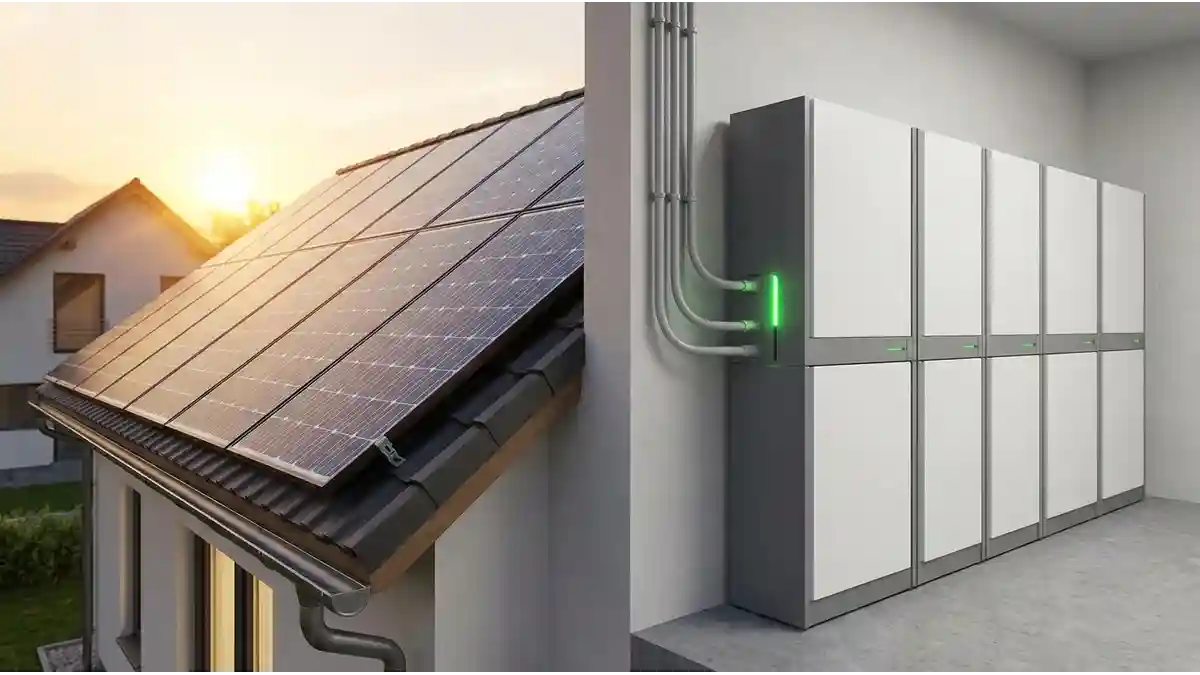
Capacity and power are two different specs — and both matter when comparing options.
Capacity (kWh)
Measured in kilowatt-hours, capacity tells you how much energy a unit can store. Think of it as the size of a water tank — a 15 kWh battery stores more than a 10 kWh battery.
Power Output (kW)
Measured in kilowatts, power tells you how much electricity a battery can deliver at once. Think of it as the size of the pipe coming out of the tank.
A system can have large capacity but limited power output — an important distinction if you plan to run appliances with high startup power, like air conditioners, well pumps, or refrigerators.
Always check both usable kWh and power output in kW before buying.
How Long Do Solar Batteries Last?
Modern LFP units typically last 10 to 15 years, depending on the product and usage pattern. Lead-acid batteries generally last 3 to 7 years in solar applications.
Lifespan depends on:
- Number of charge cycles
- Depth of discharge
- Operating temperature
- Charging and discharging habits
- Chemistry
- Manufacturer warranty terms
Storage capacity doesn’t usually fail suddenly — it gradually declines over time. Many manufacturers define warranty end-of-life using a remaining-capacity threshold (often 70%), so always check the specific warranty terms.
How Much Do Solar Batteries Cost in 2026?
Installed residential prices vary based on size, brand, location, electrical work, and backup configuration.
A useful planning range is roughly $850 to $1,200 per usable kWh installed, though actual quotes can fall outside this range.
For a system around 13.5 kWh, expect an installed project cost of roughly $13,000 to $16,000 before incentives, depending on the project scope.
Your final cost depends on:
- Brand and capacity
- Inverter equipment
- Backup load panel
- Main electrical panel upgrades
- Labor and permits
- Number of units installed
- Whether it’s a new system or a retrofit
See our Solar Panel Installation Cost guide for the full system investment picture.
Federal Tax Credit in 2026
The federal Residential Clean Energy Credit under Section 25D is not available for qualifying residential clean-energy property placed in service after December 31, 2025. However, state, local, and utility incentives may still be available in some areas — check current program rules before budgeting.
Federal Tax Credit for Solar Batteries in 2026
The federal Residential Clean Energy Credit under Section 25D is not available for qualifying residential clean-energy property placed in service after December 31, 2025. However, state, local, and utility incentives for solar batteries may still be available in some areas — check current program rules before budgeting for one.
Are Solar Batteries Worth It in 2026?
Sometimes — it depends on your goals.
Battery storage can be valuable even when electricity savings alone don’t produce a fast payback. Consider one if you want:
- Backup power during outages
- Protection from high evening electricity prices
- More control over when you use solar energy
- Less dependence on the grid
- Better use of your own solar power when export payments are low
Solar panels are usually purchased to cut electricity costs. Battery storage is usually purchased for backup power and energy control, with bill savings as a bonus. The right decision depends on your rates, outage risk, and budget.
Solar Batteries vs. Generators: Which Is Better?
| Feature | Solar Batteries | Fuel Generator |
|---|---|---|
| Fuel needed | No | Yes |
| Noise | Very quiet | Usually loud |
| Automatic backup | Yes, with proper setup | Yes, with proper setup |
| Maintenance | Relatively low | Regular maintenance |
| Emissions at point of use | None | Produces exhaust |
| Runtime | Limited by stored energy | Limited mainly by fuel |
| Solar charging | Yes, with compatible system | No |
A battery delivers quiet, quick backup but has limited stored energy. Fuel generators can run indefinitely with enough fuel. Some homeowners pair both — one for shorter outages, a generator for longer ones.
See our Portable Solar Power Generator guide for battery-based portable options.
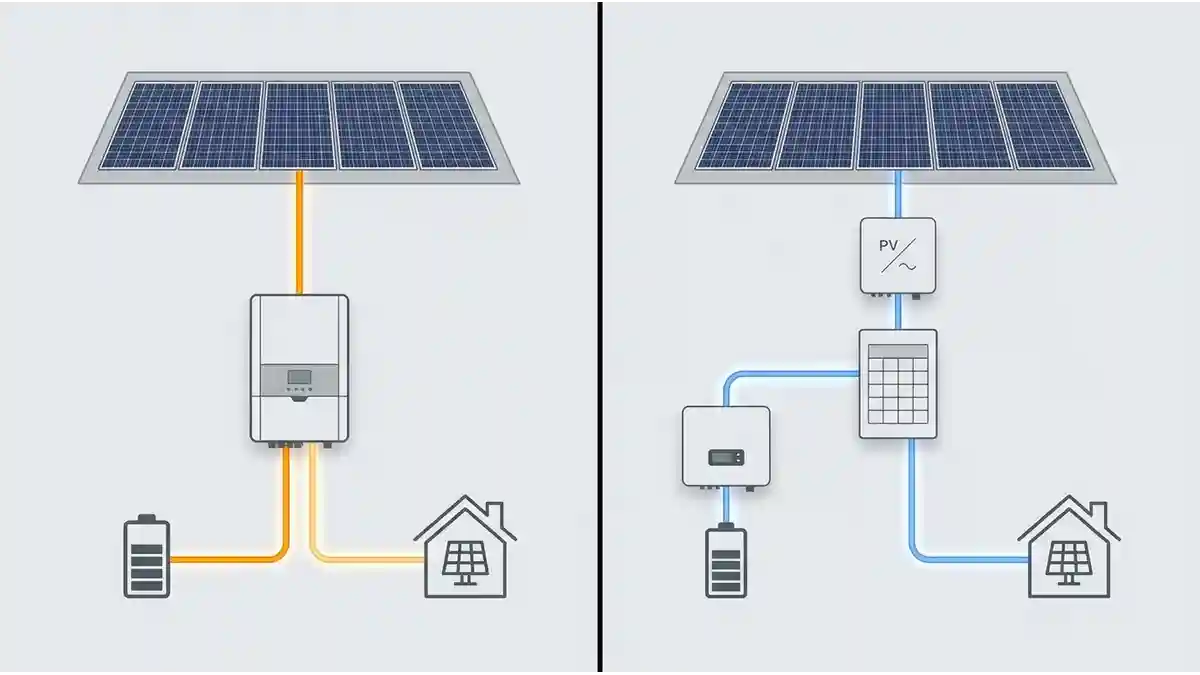
AC-Coupled vs. DC-Coupled Solar Batteries
AC-Coupled
Connected on the AC side of the inverter — a common choice when adding storage to an existing solar system.
Pros: Great for retrofits, works with existing equipment, flexible. Con: Slightly lower efficiency due to extra conversions.
DC-Coupled
Connected on the DC side before conversion — often reduces conversion losses.
Pros: Can be more efficient, good for new solar-plus-storage builds. Con: Retrofitting can be more complex.
Your existing solar inverter will strongly influence which setup makes sense for your home.
Round-Trip Efficiency of Solar Batteries
Round-trip efficiency measures how much energy you get back after charging and discharging. If you put 100 kWh into solar batteries and get 90 kWh back, efficiency is 90%.
Higher efficiency means less energy lost to conversion and storage. It’s an important spec, but shouldn’t be the only factor — capacity, power output, warranty, and price matter too.
Are Solar Batteries Safe?
Yes, when properly designed and installed. LFP chemistry is widely used in home solar batteries because of its thermal stability and long cycle life. Still, because these systems store large amounts of energy, professional installation matters.
A qualified installation should follow:
- Manufacturer instructions
- Local electrical codes
- Fire and building requirements
- Required clearances
- Proper electrical protection
- Temperature guidelines
Don’t treat a home battery as a DIY appliance. Use an installer experienced with solar and storage — see our Solar Installation Companies guide.
What to Look for When Buying Solar Batteries
- Usable capacity (kWh) — not just the rated total.
- Continuous power output (kW) — how much electricity it can deliver at once.
- Surge/starting power — important for AC units, pumps, and compressors.
- Round-trip efficiency — less energy lost per cycle.
- Warranty — years, guaranteed capacity, cycle limits, throughput limits.
- Backup capability — ask which circuits stay powered during an outage.
Best Solar Batteries in 2026: Top Brands to Compare
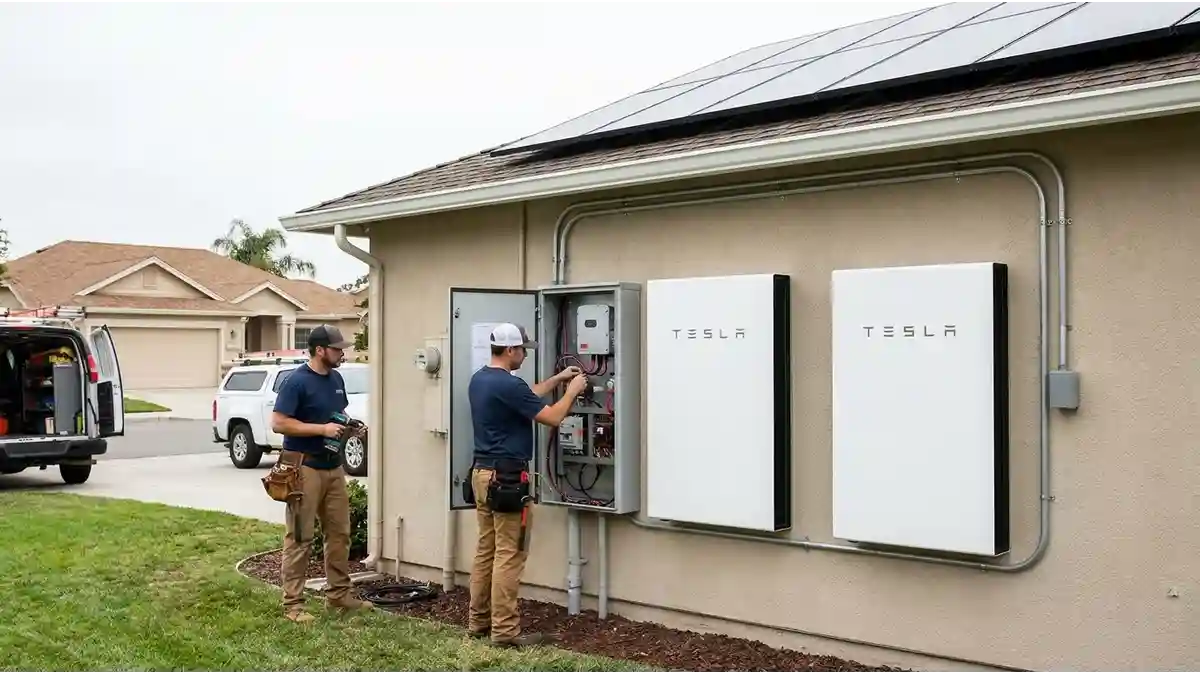
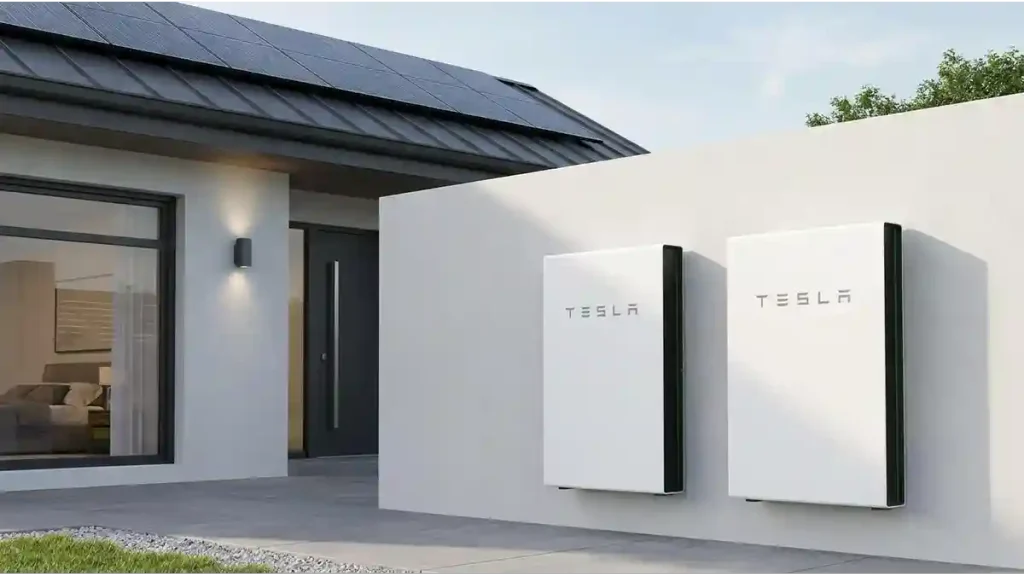
- Tesla Powerwall — popular for integrated home energy storage and backup.
- Enphase IQ Battery — a strong fit for homes already using Enphase microinverters.
- Generac PWRcell — appeals to homeowners wanting storage paired with Generac’s backup-power lineup.
Battery models, prices, and specs change often — always compare current manufacturer data before buying. See our SolarEdge vs Enphase vs Tesla vs Sol-Ark comparison for inverter compatibility.
Solar Batteries: Pros and Cons
Pros
- Backup power during outages
- Stores extra solar electricity for later use
- Can reduce evening grid electricity use
- Helps with time-of-use rate plans
- Quiet operation, no fuel needed
- Increases use of your own solar power
Cons
- High upfront cost
- Capacity decreases over time
- Eventually needs replacement
- Payback period can be long
- Whole-home backup may require multiple units
- Installation may need electrical upgrades
The real question isn’t “are solar batteries good?” — it’s “does the value of backup power and energy control justify the cost for my home?”
How Long Can Solar Batteries Power a House?
It depends entirely on your home’s electricity use.
A simple formula: usable battery capacity ÷ average power use = approximate runtime
For example, 10 kWh of solar batteries supplying a 1 kW average load could theoretically provide about 10 hours of power before accounting for system losses. Running only a fridge, lights, and Wi-Fi extends runtime; running central AC, an electric oven, or an EV charger shortens it significantly.
Solar Batteries: Frequently Asked Questions
How long do solar batteries last?
Modern LFP units typically last 10 to 15 years, depending on usage and conditions. Lead-acid batteries usually last 3 to 7 years.
How much do solar batteries cost in 2026?
Installed systems generally cost $850 to $1,200 per usable kWh. A 13.5 kWh setup may run $13,000 to $16,000 installed before incentives.
Do I need solar batteries if I already have solar panels?
No. Solar panels function fine without one. Adding storage brings backup power and the ability to use solar electricity after sunset.
How many solar batteries does a house need?
It depends on your energy use. 10–20 kWh typically covers essential loads, while 20–40+ kWh is needed for whole-home backup, along with sufficient power output.
Can solar batteries power a whole house?
Yes, if properly sized with enough usable capacity and power output to handle your home’s largest loads.
Can solar batteries work during a power outage?
Yes, if the system is designed for backup power with the right equipment and configuration.
Can solar panels charge a battery during a blackout?
Yes, in compatible solar-plus-storage systems that can disconnect from the grid and manage production safely during an outage.
What’s the difference between kW and kWh?
kWh measures how much energy a battery can store. kW measures how much power it can deliver at once.
What size solar batteries do I need?
Most homes start with 5–10 kWh for basic backup, 10–20 kWh for essential loads, and 20–40+ kWh for whole-home backup — based on your appliance list and goals.
Are solar batteries safe?
Yes, when properly installed following manufacturer instructions and local electrical/fire codes.
Can solar batteries save money?
Yes, especially with expensive peak electricity rates or low solar export credits. Factor in the upfront cost when calculating payback.
Can solar batteries work without solar panels?
Some can. They may charge from the grid, but solar charging during an outage requires compatible solar-plus-storage equipment.
Final Takeaway: Are Solar Batteries Worth It?
They aren’t automatically necessary for every homeowner. If you deal with frequent outages, high evening electricity rates, or low compensation for excess solar power, adding one can be a smart move. If you have strong net metering and rarely lose power, the financial case is weaker.
Before buying, compare:
- Usable capacity
- Power output
- Battery chemistry
- Round-trip efficiency
- Warranty
- Backup capability
- Installation cost
- Utility rates and incentives
Choose a system that matches what you need to power, how long you need backup, and what you’re willing to spend — not just the biggest kWh number on the spec sheet.
About the Author
Munir Ahmed is a solar energy writer and researcher focused on residential solar panels, battery storage, inverters, installation costs, and renewable energy technology in the United States. He creates practical guides that help homeowners compare equipment, evaluate storage options, and make informed decisions before going solar.
Last updated: August 2026