Solar Installation Companies: The Complete 2026 Buyer’s Guide
Everything homeowners need to compare solar installers, understand real costs, and avoid costly mistakes — explained in plain, simple language.

01. Solar Installation Company vs. Manufacturer: What’s the Difference
People searching for a solar installation company are usually looking for one of two different businesses. Mixing them up leads to confusion fast.
A solar installation company (also called an installer or solar contractor) is the business that visits your home, designs your system, files permits, and puts the panels on your roof. A solar panel manufacturer is the factory that builds the actual panels — companies like REC, Qcells, or LONGi. Most installers do not make their own panels. They buy panels from a manufacturer and install them for you.
| Type | What they do | Example |
|---|---|---|
| Manufacturer | Builds the physical solar panels | REC, Qcells, LONGi, Canadian Solar |
| Installer (solar contractor) | Designs, permits, and installs your system | Sunrun, Palmetto, local installers |
| Full-service provider | Sells, finances, and installs — but doesn’t manufacture | Most national brands |
| Lead-generation site | Collects your info and passes it to installers | Comparison marketplaces |
When you compare a list of solar power installation company options, check whether each name actually installs systems or is just a lead-generation site. Both have a place, but they are not the same service.
02. How to Choose a Solar Installation Company
Check the license, the NABCEP certification, the workmanship warranty, recent reviews, and get three quotes before you sign anything.
1. Verify the license
Every legitimate installer needs a state electrical contractor license. Check your state’s licensing board site directly. Do not just take the salesperson’s word for it.
2. Look for NABCEP certification
The North American Board of Certified Energy Practitioners (NABCEP) issues the solar industry’s top credential for individual installers. At least one NABCEP-certified installer should be on staff.
3. Compare workmanship warranties
A 15-to-25-year workmanship warranty signals a company that trusts its own work. A 5-year warranty is a warning sign.
4. Read recent reviews, not just star averages
Look for a 4.0-star rating or higher with at least 50 reviews on Google, the Better Business Bureau, or SolarReviews. Read the actual complaint details, not just the number of stars.
5. Get at least three quotes
Comparing cost-per-watt across three companies makes it obvious if one quote is inflated.
03. Best Solar Installation Companies in 2026
There is no single universal “best” solar installation company. It depends on your state, your budget, and whether you want to own or lease your system.
Based on 2026 reviews across ConsumerAffairs, Forbes Home, and EnergySage, these ten names consistently rank at or near the top of national comparisons.
| Company | Known for | Pricing | Workmanship warranty |
|---|---|---|---|
| Sunrun | Largest lease/PPA provider in the U.S. | Varies by plan | 10 years |
| Palmetto Solar | Wide installer network, “Protect” monitoring plan | $3.20–$4.20/watt | 10 years |
| Blue Raven Solar | In-house installers, clear step-by-step process | Comprehensive quotes | 10 years |
| ADT Solar (Sunpro) | Established name, bundled home security tie-ins | Mid-to-premium | Varies |
| SunPower (via dealers) | Premium high-efficiency panels | $4.00–$5.50/watt | 25 years |
| Freedom Forever | Large national footprint, fast install crews | Competitive, varies by region | 10–25 years |
| Trinity Solar | One of the oldest residential installers in the U.S. | Competitive, varies by region | Varies |
| Tesla Energy | Algorithm-based pricing, subcontracted install crews | $3.00–$4.50/watt | 10 years |
| Momentum Solar | Strong Northeast and California presence | Varies by region | Varies |
| Elevation | Smart-home integrated systems, high customer ratings | Mid-to-premium | Varies |
Who is the most reputable solar installation company? Reputation tracks two things: how long a company has operated without a bankruptcy or major restructuring, and how it handles warranty claims after year one. Older, established regional installers often beat newer national names on this measure, even when the national brand spends more on marketing.
Who is the leading company in solar installation? By install volume, Sunrun leads the U.S. residential lease/PPA market. By panel manufacturing volume, LONGi and JinkoSolar lead globally. These are two different “leading” companies depending on whether you mean installer or manufacturer.
The best solar installation company for you personally is the one that answers your questions clearly, shows you an itemized quote, and has verifiable reviews in your actual service area — not necessarily the biggest name. See our five checks for choosing an installer above before you request quotes, and check out our dedicated look at Tesla solar panels if that name is on your shortlist. For a plain-language walkthrough of the whole process, see our solar panel installation guide.
04. Top Solar Panel Manufacturers Compared
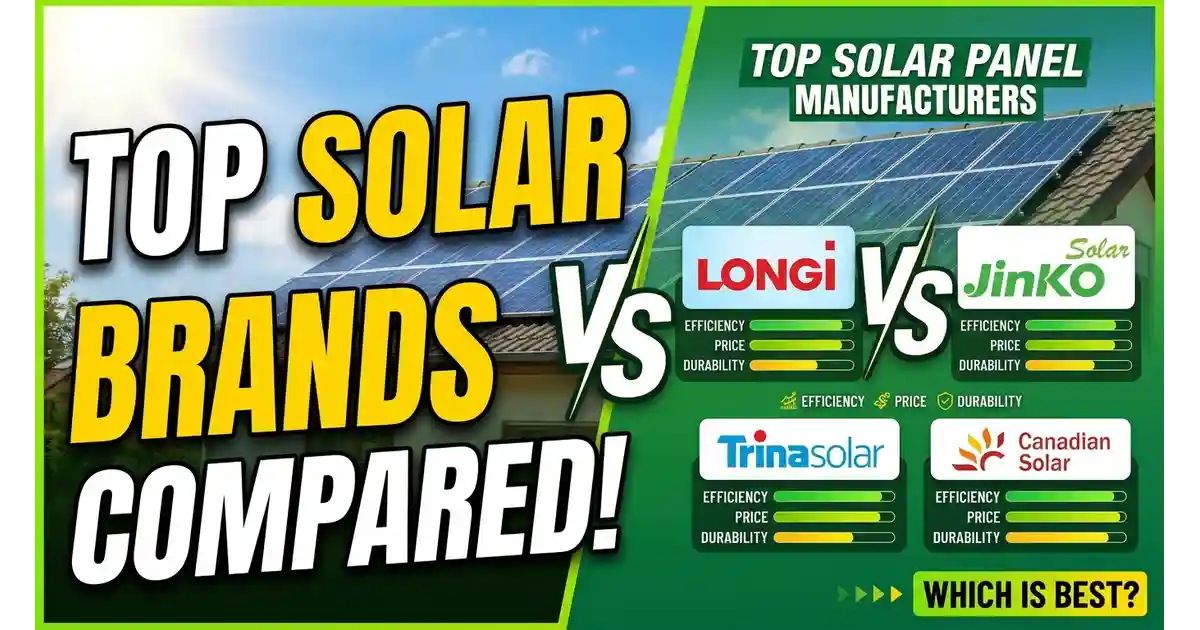
It also helps to know the top solar panels manufacturers, since this is what actually goes on your roof, regardless of which installer you hire. Most residential quotes today are built around monocrystalline solar panels, and you can review each brand’s full spec sheet, including options like Maxeon solar panels, before comparing installers.
| Manufacturer | Efficiency | Product warranty | Performance warranty | Tier |
|---|---|---|---|---|
| Maxeon (SunPower) | Up to 22.8% | 40 years | 40 years | Premium |
| REC | Up to 22.3% | 20–25 years | 25 years | Premium |
| Qcells | ~21% | 25 years | 25–30 years | Mid-premium, U.S. manufacturing |
| LONGi | ~21–22% | 12–15 years | 25 years | High-volume, all-climate |
| Canadian Solar | ~20–21% | 25 years | 30 years | High-volume |
| Hyundai | ~20–21% | 25 years | 25 years | Value |
Among the biggest manufacturers by global shipment volume, LONGi, JinkoSolar, JA Solar, Trina Solar, and Canadian Solar dominate the market. Most are based overseas, which is not automatically a problem, but it does mean warranty support runs through a U.S. distributor or your installer, not a local factory.
A quick honest note: the difference between a 21% and a 22.8% efficiency rating usually adds up to a handful of extra kilowatt-hours a year, not a dramatic bill change. Installation quality and warranty backing matter more to your long-term experience than squeezing out one extra efficiency point. If you want the full technical breakdown, see our guide to the types of solar panels before you request quotes.
05. Commercial Solar Installation Companies: How They Differ From Residential Installers
Commercial solar installation companies size and permit much larger systems for warehouses, offices, and multi-unit buildings, and they typically quote in total project cost rather than cost per watt.
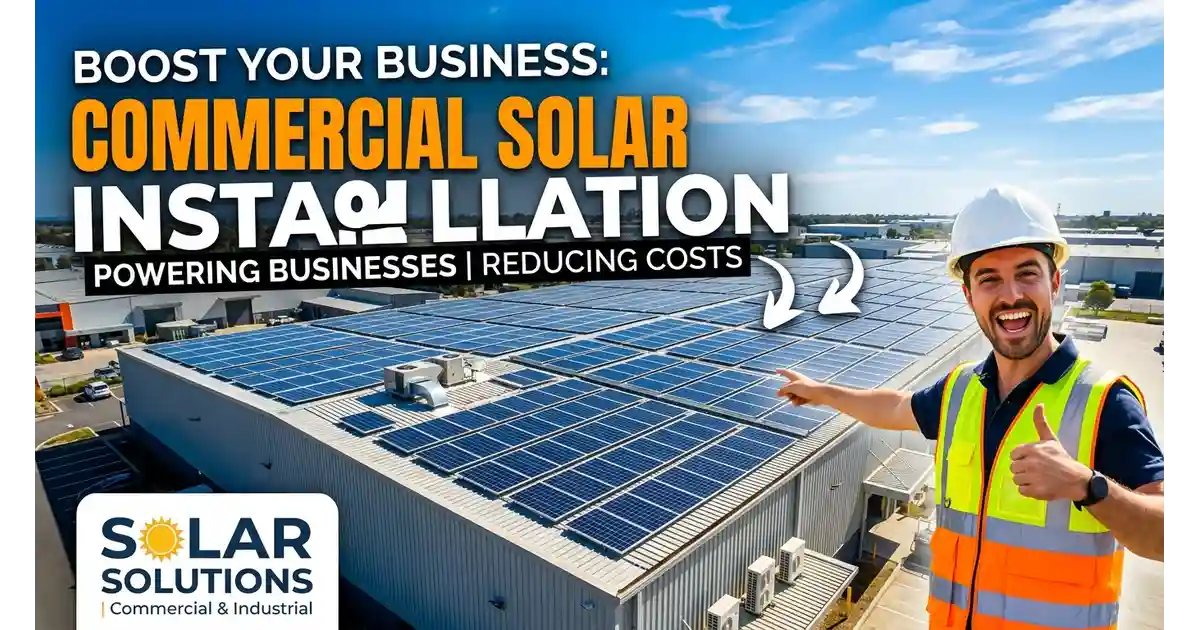
A residential installer is built to run a standard, repeatable process: one roof, one utility meter, one homeowner signing the contract. A commercial project usually involves a larger roof or ground-mount array, three-phase electrical service, more complex permitting, and sometimes a separate engineering review before construction can start. Not every residential installer takes on commercial work, so ask directly whether a company has completed projects at your building’s scale.
| Factor | Residential installer | Commercial solar installation company |
|---|---|---|
| Typical system size | 5–15 kW | 50 kW–multiple MW |
| Electrical service | Single-phase | Often three-phase |
| Financing | Loan, lease, PPA, cash | PPA, commercial loan, tax equity, cash |
| Typical timeline | 60–120 days | 6–18 months |
| Tax incentive | 30% residential ITC | Commercial ITC plus possible depreciation benefits |
If you are sourcing bids for a business property, ask each commercial solar installation company for references from a project of similar size, proof of a commercial general liability policy, and an engineering stamp on the system design — residential red flags apply here too, just at a larger dollar amount.
06. How Much Does Solar Installation Cost in 2026?
Most homeowners pay between $2.50 and $4.50 per watt before any incentives, or roughly $15,000 to $30,000 for a typical 6kW to 10kW home system. See our full breakdown of what it costs to install solar panels, or run your own numbers with our solar panel calculator.
| System size | Average homes it fits | Estimated cost range |
|---|---|---|
| 5 kW | Small home, low usage | $12,500–$22,500 |
| 7 kW | Average U.S. home | $17,500–$31,500 |
| 10 kW | Larger home or high usage | $25,000–$45,000 |
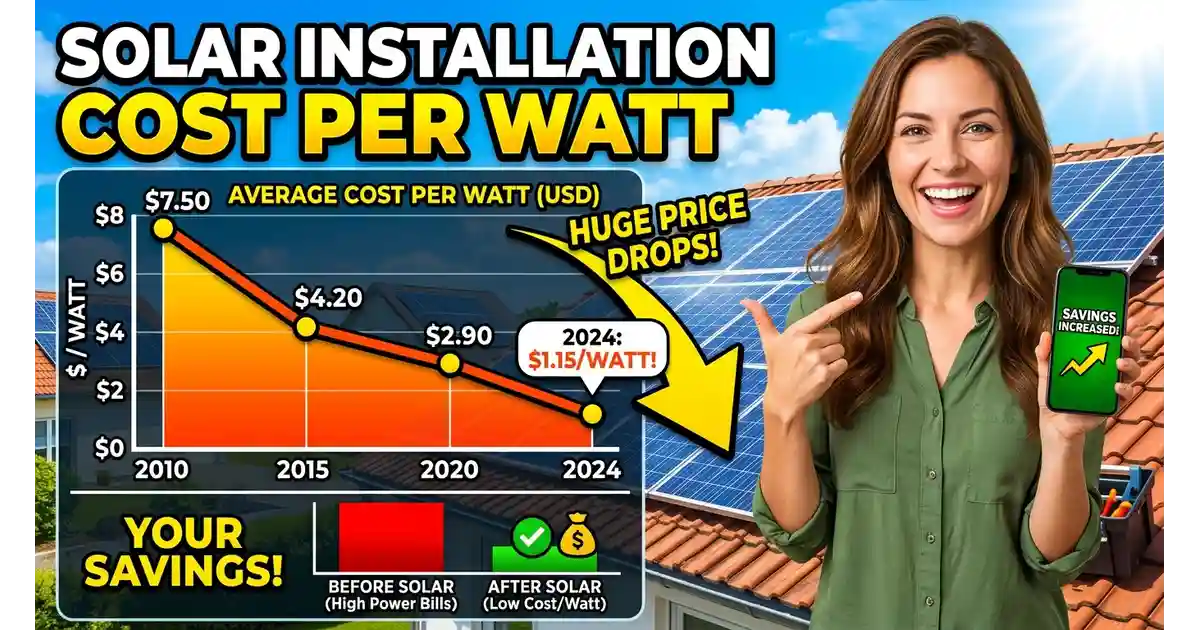
Five things push your price up or down:
- Roof complexity. Steep pitches, multiple angles, or old roofing add labor cost.
- Panel brand. Premium manufacturers like Maxeon cost more per watt than value brands.
- Battery add-ons. A home battery can add $10,000–$20,000 to the project.
- Your state. Permitting fees, labor rates, and incentive programs vary widely by state.
- Financing type. Loans and cash purchases usually cost less over time than a lease or PPA.
07. How to Pay for Solar: Financing Options Explained
Cash and loans give you ownership and the tax credit. Leases and PPAs give you $0 upfront but usually smaller lifetime savings.
| Option | Who owns the panels | Best for | Trade-off |
|---|---|---|---|
| Cash purchase | You | Lowest lifetime cost, biggest tax credit benefit | Highest upfront cost |
| Solar loan | You | Homeowners who want ownership without a big upfront payment | Interest adds to total cost |
| Solar lease | The solar company | Homeowners who want $0 upfront and no maintenance hassle | You don’t get the federal tax credit; savings are usually smaller |
| Power Purchase Agreement (PPA) | The solar company | Homeowners who just want to pay less than their utility rate | You pay for power produced, not a fixed system price |
If long-term savings matter most to you, a cash purchase or solar loan usually wins. If low upfront cost and simplicity matter most, a lease or PPA can make sense, even though total savings are typically lower.
08. The Federal Solar Tax Credit (ITC): What You Need to Know
The federal Investment Tax Credit lets owners deduct 30% of system cost from federal taxes. It applies to purchases, not leases or PPAs.
If you purchase a solar system, you may qualify for the federal Investment Tax Credit (ITC), which lets you deduct 30% of your total system cost from your federal taxes. This credit generally applies to systems you own outright, either through cash or a solar loan — it typically does not apply if you lease your system or sign a PPA, since the leasing company owns the equipment.
09. The Solar Installation Process: 7 Steps From Quote to Power-On
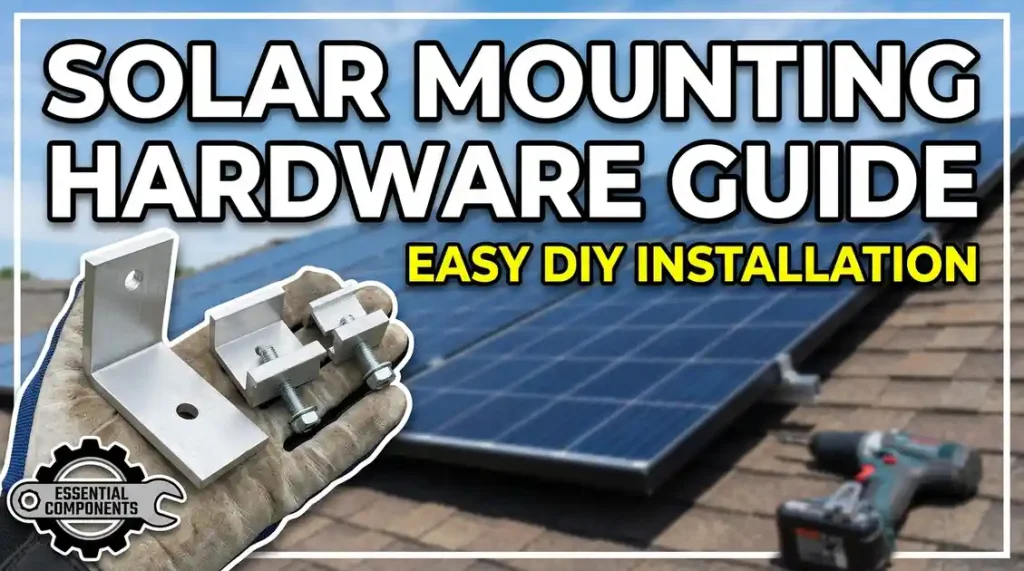
Consultation, design, contract, permitting, install day, inspection, then utility activation — permitting and utility approval take the longest. Curious how it all fits together on the roof? See how solar panels work and what mounting hardware installers typically use.
| Step | What happens | Typical time |
|---|---|---|
| 1. Consultation | A solar advisor reviews your electric bill, roof, and shading | 1–2 weeks |
| 2. System design | Your installer designs panel layout and picks equipment | 1 week |
| 3. Contract & financing | You review the contract, warranty terms, and pick a payment method | Varies |
| 4. Permitting | Installer files building and electrical permits with your city or county | 30–45 days |
| 5. Installation day | Crew mounts panels, wiring, and inverter on your roof | 1–3 days |
| 6. Inspection | A local inspector confirms the system meets code | 1–2 weeks |
| 7. Utility approval & activation | Utility grants Permission to Operate (PTO) and your system turns on | 2–4 weeks |
Add it up, and the full journey from signed contract to activation usually takes 60 to 120 days. Permitting and utility approval, not the physical install, are almost always the slowest part.
10. Is DIY Solar Installation a Good Idea?
You technically can install panels yourself, but most homeowners should not — it risks your warranty, your permit, and your safety. If you’re comparing DIY, look closely at what’s actually in a solar panel kit before assuming it will cost less than hiring a pro.
- Warranty risk: Many manufacturers void the panel warranty if a certified installer did not do the work.
- Permit risk: Cities often reject permits for non-licensed electrical work.
- Safety risk: Rooftop electrical work carries real fall and shock hazards.
- Grid connection risk: Utilities usually require sign-off from a licensed installer before granting Permission to Operate.
Professional installation costs more upfront, but it protects your warranty, your safety, and your ability to actually connect to the grid.
11. Solar Battery Storage: Do You Need One?
A battery is optional. It stores extra power for use at night or during an outage, and typically adds $10,000–$20,000 to a project.
A battery, such as a Tesla Powerwall or an Enphase battery, stores extra solar power so you can use it at night or during a power outage. It is optional; your panels will work fine without one.
A battery is worth considering if you live somewhere with frequent outages, if your utility no longer offers strong net metering, or if you want backup power for essential appliances. Expect it to add $10,000–$20,000 before incentives.
12. Solar Installation Companies to Avoid: Red Flags
There is no universal published list of solar companies to avoid, since the industry shifts fast — companies rebrand, merge, or go out of business every year. Instead, watch for these red flags no matter which company you are evaluating.
If a warranty claim gets denied and blamed on “installation error” every time, and the company has no track record of honoring claims, that is the real signal to walk away, no matter what the spec sheet promises. You can check complaint history directly through the Better Business Bureau before signing.
13. Finding a Solar Installation Company Near You
Local search matters here. “Best” usually really means “best available where you actually live.” Start with a search for solar installers near me to see who actually serves your zip code, then narrow from there. A few examples of how this plays out:
- San Antonio, TX: Installers should be licensed with the Texas Department of Licensing and Regulation and familiar with CPS Energy’s interconnection rules, since Texas does not have statewide net metering.
- Warsaw, Indiana: Indiana offers a property tax deduction and an Energy Community bonus in certain coal counties, so a local installer who knows these details is worth more than a national call center.
- Brandon, FL or Brandon, MS: Installs typically run $3.50–$4.00 per watt before incentives, with several regional installers competing directly against national brands.
- California: Net metering rules and permitting vary heavily by utility, so it’s worth reading how the numbers work for solar panels in California specifically before comparing installers.
The pattern across all three: national companies bring financing options and brand recognition, but a local installer usually knows your utility’s rules, permitting office, and climate conditions better. Getting one quote from a national name and two from local installers, or checking a marketplace like EnergySage’s installer directory, which screens installers by license and reviews, tends to give the clearest overall picture.
14. The Biggest Myth About Solar Installation Companies
Myth: the lowest quote is the best deal. Reality: compare cost per watt and warranty length, not just the bottom-line price.
Myth: “The company with the lowest quote is the best deal.”
Reality: A bid that is 30% or more below the market average for your area usually means one of three things: lower-grade equipment, subcontracted crews with less oversight, or “add-on” costs that appear after you have already signed. Comparing quotes by cost per watt, not the bottom-line total, is the only way to know if you are looking at a fair price or a stripped-down system with a scary bill waiting later.
A $3.00-per-watt quote with a 10-year workmanship warranty can be worse value than a $3.50-per-watt quote backed by 25 years of coverage, especially if something goes wrong in year 12. See the comparison table above for how warranty length varies by company.
15. Is Solar Worth It? Payback Period and ROI
Most homeowners recover their system cost in 6 to 10 years, then get largely free power for the rest of a 25-to-30-year warranty. For a deeper dive into the numbers, see our full analysis of whether solar panels are worth it.
Your actual payback period depends on your system cost, your local electricity rate, how much sun your roof gets, and whether your utility offers full-retail net metering. A local installer can run these numbers for your specific home before you sign anything.
16. Solar Installation Jobs: A Different Kind of Search
If you searched for solar panel jobs or solar companies hiring in Houston, you are likely looking for employment in the industry, not a company to install panels on your home. That is a genuinely different search than everything above.
The solar workforce has grown fast. Installers, electricians, and sales roles are in demand nationally, and Houston specifically has multiple active installers hiring both experienced electricians and entry-level installation crew. Check job boards directly or the careers pages of national installers like Sunrun, Palmetto, and regional Texas companies.
Frequently Asked Questions
Who is the most reputable solar installation company?
Reputation depends on operating history and how well a company handles warranty claims after installation, not just marketing reach. Long-running regional installers often score as well as, or better than, national names.
Who is the best solar installation company?
There is no single best. It depends on your location, budget, and whether you want to own or lease. Get quotes from at least one national name and two local installers to compare.
How much does solar panel installation cost in 2026?
Most homeowners pay $2.50–$4.50 per watt before incentives, or roughly $15,000–$30,000 for a typical 6kW–10kW system. The 30% federal tax credit can lower that cost significantly.
How long does solar installation take?
The physical install usually takes one to three days, but the full process from signed contract to activation typically takes 60 to 120 days because of permitting and utility approval.
Can I install solar panels myself?
You can, but most homeowners should not. DIY installs can void equipment warranties, fail inspections, create safety hazards, and complicate utility approval.
Is solar installation worth it?
For most homeowners with a sunny roof and decent electricity rates, yes. Typical payback periods run 6 to 10 years, with 25–30 years of production after that.
Are there solar installation companies to avoid?
No specific universal list exists since the industry changes fast, but red flags like high-pressure sales, vague quotes, and zero-bill guarantees apply no matter which company you are considering.
What is a commercial solar installation company?
A commercial solar installation company designs and builds larger systems for businesses, typically with three-phase electrical service, engineering review, and financing structured around the commercial tax credit.
Bottom Line
There is no single “best” solar installation company for everyone. The right one depends on where you live, how much you want to spend, and whether ownership or leasing fits your situation better. Check licensing and NABCEP certification, compare at least three quotes by cost per watt, understand the 7-step install timeline, and read recent reviews closely before signing anything. A slightly higher quote backed by a real warranty almost always beats the cheapest bid on the table.