Portable Solar Panels: The Complete 2026 Buying Guide
Foldable vs. flexible vs. rigid, top picks by use case, sizing math, and an honest look at what portable solar can and can’t do.
Portable solar panels are solar panels built to be moved rather than permanently bolted down — foldable, flexible, or briefcase-style units that convert sunlight into DC power for camping gear, RVs, boats, and portable power stations, without a fixed rooftop install.
01. What Counts as a Portable Solar Panel?
A portable solar panel is any panel built to be moved, not bolted down for good. That covers three product families — foldable, flexible, and rigid-but-carried — that behave very differently in real use.
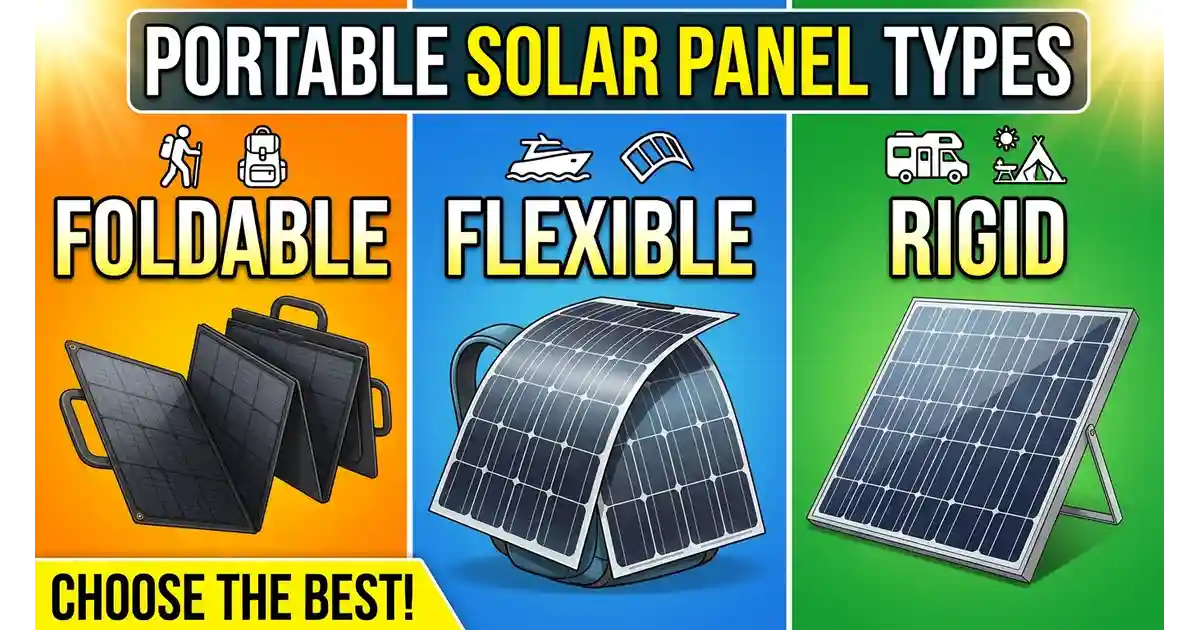
In practice, that covers three product families that get lumped together in search results but behave very differently.
| Type | Body | Typical weight (100W) | Typical use |
|---|---|---|---|
| Foldable / briefcase panel | Rigid glass or semi-rigid segments hinged together | 15–20 lbs | Camping, overlanding, emergency kits |
| Flexible panel | Thin polymer or fiberglass laminate, no glass | 3–5 lbs | RV roofs, boats, vans, curved surfaces |
| Rigid panel | Aluminum frame plus tempered glass | 15–20 lbs | RV roof racks, permanent van builds, home backup |
A foldable panel is portable but rigid inside each segment. It is a “suitcase” of standard glass-backed cells. A flexible panel can be glued to an RV roof and never move again, yet it is still called “portable” because it does not need a fixed frame. Which one you need depends on whether you carry the panel to the sun each time (foldable) or mount it once to a curved surface (flexible). For a rooftop, permanently wired comparison, see our RV solar panels guide.
02. Flexible vs. Rigid Solar Panels (and Where Foldable Fits In)
Rigid panels win on efficiency, lifespan, and cost per watt; flexible panels only win on weight and curved-surface fit. Foldable panels sit in between, using rigid cells in a hinged, portable body.
This is the single most-searched comparison in this category, and most articles skip how much heat actually costs you in real output. Here is the full picture.
| Factor | Foldable | Flexible | Rigid |
|---|---|---|---|
| Real-world efficiency | 21–25% (monocrystalline) | 15–22%, often lower when hot | 20–25% |
| Lifespan | 10–25 years | 5–15 years | 25–40 years |
| Weight (100W) | 15–20 lbs | 3–5 lbs | 15–20 lbs |
| Heat performance | Good — stored flat, not permanently mounted | Poor — no air gap, can lose 10–25% output when hot | Best — mounted with an air gap for cooling |
| Mounting | None — sets on ground or kickstand | Adhesive or fasteners, no drilling | Brackets, usually needs drilling |
| Best for | Campers, hikers, emergency kits | Curved roofs, vans, boats, weight-limited builds | Permanent installs, maximum longevity |
| Cost per watt | Moderate | Highest | Lowest |
The practical takeaway: rigid solar panels win on every performance and longevity metric. They simply cannot bend, and they are heavier. Flexible solar panels solve one problem rigid panels cannot: shape or weight. If your roof is flat and can handle the weight, go rigid — see our monocrystalline solar panels guide for the cell technology behind that recommendation. If your roof curves or your rig cannot handle 20-plus extra pounds, flexible is the only option that physically fits, but budget for replacing it sooner. Foldable panels sit in between. They use the same rigid, glass-backed cells as permanent panels, just hinged so they pack down for transport, which is why they outlast flexible panels while still being genuinely portable.
03. Best Portable Solar Panels for Camping, by Use Case
The best portable solar panels for camping depend on your trip type, not a single “best” model. Match wattage to your actual daily energy use — a solo hiker and a family in an RV need very different systems.
Rather than one “best portable solar panel” ranking, which ignores that a solo hiker and a family of four need very different systems, match wattage to your actual trip.
| Use case | Recommended wattage | What it runs |
|---|---|---|
| Solo hiker / backpacker | 20–60W | Phone, GPS, headlamp, small power bank |
| Weekend car camper (solo/couple) | 100W | Phone, small power station, LED lighting |
| Couple in a van (4–7 nights) | 200W | 12V fridge, fan, two devices charging |
| Family RV trip (1–2 weeks) | 200W foldable plus rooftop rigid array | Fridge, lighting, fans, device charging |
| Overlanding / extended off-grid | 300–400W+ | Fridge, induction cooktop, larger power station |
The wattage on the box is a lab rating, not a guarantee. In real outdoor use, with imperfect angle, partial cloud cover, and morning or evening light, most portable solar panels produce roughly 30–70% of rated output over a full day, though during clear midday peak sun some panels reach 70–85% of rated wattage. Budget for that gap rather than assuming a “200W panel” delivers 200W for eight straight hours.
Angle matters more than price. Tilting a panel 30°–45° toward the sun, instead of laying it flat, typically recovers 15–25% of the output most buyers wrongly blame on the panel itself. It is the single biggest free performance lever in this category.
04. Best Portable Solar Panels by Category (2026)
The best portable solar panels vary by use case — Jackery SolarSaga leads for all-around reliability, EcoFlow for wet-weather trips, and EGO for buyers already inside the EGO power ecosystem.
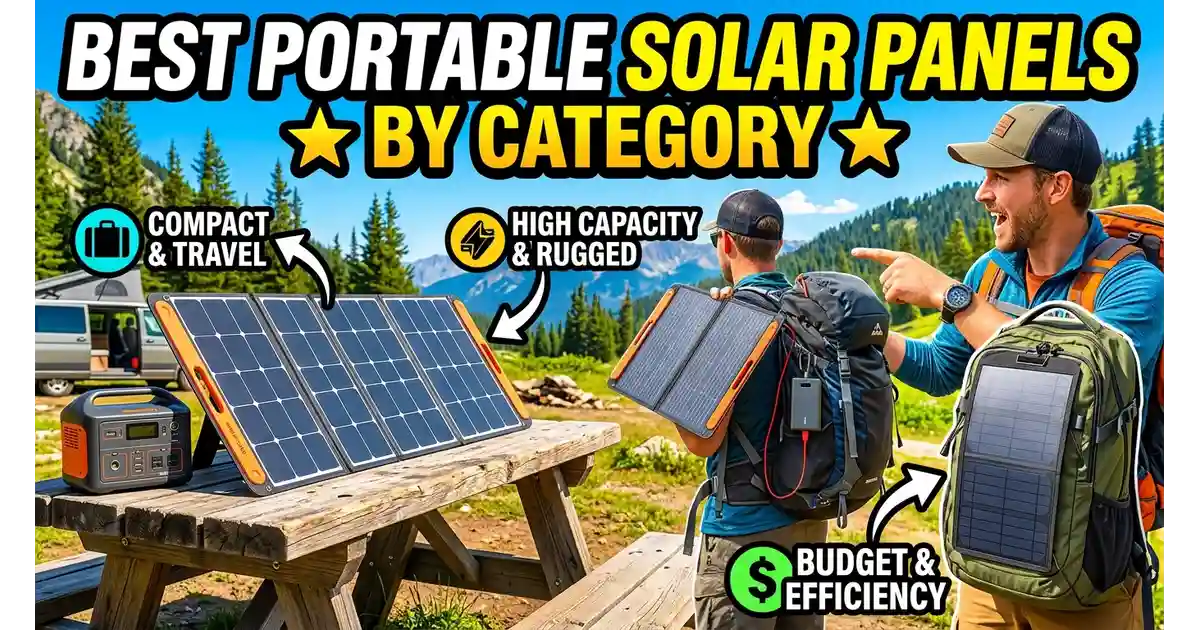
Specific models come and go, and prices shift often, so treat this as a starting shortlist to research current pricing and reviews on, not a final buy decision. These are the panels most frequently recommended across 2026 buying guides for each use case.
| Category | Frequently recommended pick | Why it’s picked |
|---|---|---|
| Best all-around / most people | Jackery SolarSaga 100W–200W series | Consistent output, wide power-station compatibility, proven reliability |
| Best for wet or rugged trips | EcoFlow 160W–220W (some bifacial models) | High IP65–IP68 waterproofing; bifacial versions capture reflected light |
| Best for high efficiency | BLUETTI PV200 series | Around 23% conversion rate, foldable to a compact size |
| Best for RV / overlanding | Renogy 200W foldable | Rugged build, good output for longer off-grid stays |
| Best ultralight for backpacking | BigBlue 28W or Goal Zero Nomad 50 | Low weight, enough output for phones and small power banks |
| Best budget option | BougeRV 200W | Strong efficiency for the price, works with most power stations via an adapter cable |
EGO 100 Watt Solar Portable Panel: Where It Fits
The EGO 100 watt solar portable panel is built to pair with EGO’s own Nexus and Power+ portable power stations, rather than the MC4-based ecosystem most camping panels use. It makes the most sense for buyers who already own EGO outdoor power equipment (lawn tools, generators) and want one connector standard across their gear, not for someone shopping panels in isolation. Expect similar wattage and weight to other 100W foldable panels in this category, with the trade-off being proprietary compatibility instead of universal MC4.
Whichever brand you pick, confirm three things before buying: the connector type matches your power station (or you have the right adapter), the panel’s rated wattage fits your use case from the table above, and the waterproof rating fits your climate.
05. Foldable Solar Panels: What to Look For
A good foldable solar panel comes down to five specs: monocrystalline cells, an ETFE surface, IP65+ waterproofing, built-in USB output, and a standard MC4 connector.
A foldable solar panel is the default camping choice because it combines near-rigid-panel efficiency with genuine portability. Here is what separates a good one from a disappointing one.
- Cell type: Monocrystalline cells (21–25% efficiency) outperform polycrystalline (15–18%) in the same footprint. Check the spec sheet, not the marketing copy — budget models still ship polycrystalline.
- Surface material: ETFE-coated panels resist UV yellowing and stay clear longer than cheaper PET-laminate surfaces, and tend to shed dust in light rain with no manual cleaning.
- Waterproof rating: Look for IP65 minimum, and IP67 or higher for genuinely wet climates. Below IP65 risks permanent damage in a real downpour.
- Output ports: Built-in USB-A/USB-C ports let you charge small devices directly, without a separate power station.
- Connector type: MC4 is the industry standard for pairing with portable power stations. Confirm compatibility, or the adapter you’ll need, before buying.
06. Flexible Solar Panels (Including RV Stick-On Panels)
Flexible solar panels exist to solve one problem: mounting solar on a curved or weight-limited surface. They trade lifespan and heat performance for that flexibility.
Flexible solar panels solve a specific problem: mounting solar on a surface that is not flat, or where every added pound matters — RV roofs with curves, vans, teardrop trailers, tents, and boat decks.
On efficiency, the most efficient flexible solar panels on the market in 2026 use N-type monocrystalline cells, which outperform the older PERC-type cells that topped out around 20–21% real-world efficiency. High-end flexible panels using N-type or IBC (interdigitated back contact) technology can reach 23%+, though mounted surface temperature, not cell technology alone, remains the biggest swing factor in actual output.
Looking for a high-efficiency flexible solar sticker panel for an RV specifically? These are thin, adhesive-backed panels applied directly to a curved RV roof section without drilling. The “high efficiency” versions use N-type or monocrystalline cells rather than budget polycrystalline laminate, and that difference matters more here than almost anywhere else in this category, since a sticker-style panel has no frame, no air gap, and no ability to be re-angled toward the sun. The cell technology underneath is doing all the work.
A few practical notes if you are going the sticker/stick-on route:
- Use high-bond mounting tape (automotive-grade VHB or marine sealant) rather than the thin adhesive strips some kits include — thin adhesive is the most common reported failure point.
- Mount on thin spacer strips rather than the full panel surface where possible, to create a small air gap that reduces heat buildup and slows adhesive failure.
- Seal panel edges with lap sealant after mounting to stop water intrusion from degrading the adhesive from underneath.
- Wire flexible and rigid panels to separate charge controllers if running both. They perform at different voltages and heat differently, so combining them on one controller drags down both.
07. Marine Flexible Solar Panels (for Boats)
Marine flexible solar panels solve the curved-deck problem on boats the way flexible RV panels solve it on a rounded roof — but salt-air life expectancy is even shorter than RV use.
Boats add a layer of difficulty land-based rigid panels are not built for: salt spray, constant vibration, and curved decks, biminis, and coach roofs. Flexible marine solar panels solve the curved-surface problem on boats the same way flexible RV panels solve it on a rounded roof.
Marine-grade panels, flexible or rigid, differ from standard panels in three ways: potted (sealed) junction boxes that resist corrosion, ETFE or tempered-glass surfaces that hold up to UV and salt exposure, and bypass diodes that keep output stable when rigging or sails cast partial shade.
| Boat size / use | Recommended wattage | Notes |
|---|---|---|
| Small boat — lights, GPS, small electronics | 100–150W | A single flexible panel usually covers this |
| Larger boat, refrigeration, more electronics | 300W+ | Combine flexible (curved surfaces) with rigid (flat deck space) |
| Sailboats with rigging/sail shading | Any wattage | Prioritize bypass diodes over raw wattage |
Flexible marine panels typically run 18–22% efficiency versus 22–25% for rigid marine panels, and last roughly 10–15 years in salt air versus 20-plus years for rigid marine-grade glass. The tradeoff is worth it specifically where a curved coach roof, bimini, or dodger canvas rules out rigid mounting. For flat deck space, rigid delivers more power per dollar over the system’s life. A land-market flexible panel not rated for marine use commonly fails within 1–2 years in salt spray, so do not substitute a cheaper RV panel here.
08. Portable Solar Panels for EV Charging: A Reality Check
A portable solar panel cannot meaningfully charge an EV. Most add just 1–3 miles of range per hour of good sun — useful as emergency backup, not as a charging method.
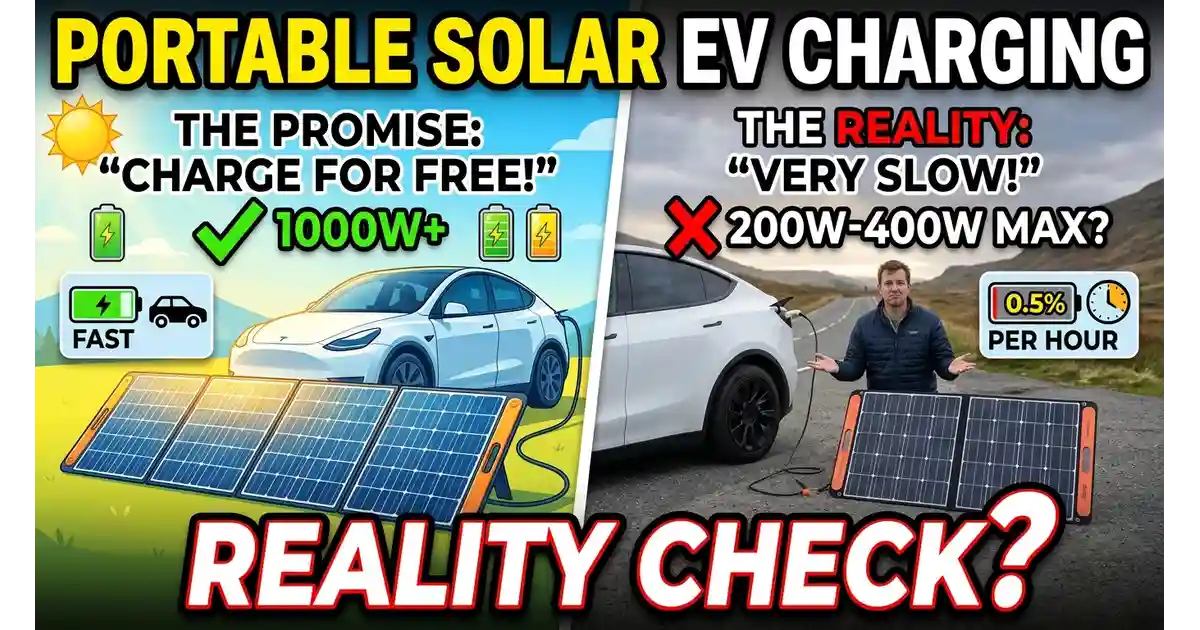
This is the search query where buyer expectations and reality diverge the most, so it is worth being direct: a portable solar panel cannot meaningfully charge an EV on its own.
The math: a typical EV uses roughly 0.3 kWh per mile, and the average driver covers about 1,200 miles a month, meaning most EVs need 300–400+ kWh a month. A home solar array sized for EV charging needs 5–10 standard 400–450W panels working with a dedicated inverter and charge controller. A single 100–200W portable panel, by contrast, typically adds only 1–3 miles of range per hour of good sun — meaningful for a phone or small power bank, not a road trip. The U.S. Department of Energy’s EV technology overview breaks down typical EV energy use in more detail.
Where portable solar panels for EV charging genuinely help:
- Emergency backup range — a portable panel paired with a solar generator can add a few miles if you’re stranded, not a full charge.
- Trickle-charging while parked for days — useful for extending range on a multi-day stop, not daily commuting.
- Offsetting camp/RV loads so the vehicle’s onboard battery isn’t drained for accessories, indirectly preserving range.
If the actual goal is “charge my EV with solar,” the honest answer is a home or roof-mounted solar system. Portable panels are an emergency supplement, not a charging solution. Our home solar panels guide covers what a properly sized rooftop system looks like.
09. How to Size Your Portable Solar Setup
Divide your daily watt-hour usage by local peak sun hours, then divide by 0.8 to account for real-world losses. That number is the wattage you need to buy.
Sizing a portable solar setup comes down to matching panel wattage to how much energy you actually use each day. Our solar panel calculator can run this math against your own appliance list.
1,500 ÷ 5 = 300W, then 300 ÷ 0.8 = 375W needed.
Two 200W panels (400W total) give comfortable headroom. Three 200W panels (600W) add surplus for cloudy days and imperfect angles.
10. Portable Power Station With Solar Panel: How Pairing Works
A portable power station with a solar panel charges at a rate set by the station’s solar input limit, not the panel’s rated wattage alone. Matching both numbers determines your real charge time.
Wattage is only half the picture. Your power station’s solar input rating decides how fast the panel can actually refill the battery.
- A power station with a 200W solar input, connected to a 200W panel, recharges roughly 200Wh per peak sun hour.
- A 1,000Wh battery takes roughly 5–6 hours of good sun to fully charge at that rate.
- Doubling solar input (400W with two panels) roughly halves the charge time.
Before buying panels, check your power station’s maximum solar input wattage and its input voltage range. Sending a panel with a higher open-circuit voltage than the station accepts can prevent charging entirely, or trip a safety cutoff.
11. Connectors and Wiring: Series vs. Parallel
Parallel wiring keeps voltage the same and adds wattage together; series wiring adds voltage instead. Check your charge controller’s input specs before choosing.
Most portable solar panels use standard MC4 connectors, which are compatible across many brands. Some panels ship with adapter cables for proprietary inputs, such as certain Jackery, Goal Zero, or EGO power stations, so check compatibility or budget for an adapter before buying.
When you run two or more panels together, how you wire them changes the outcome:
- Parallel wiring (positive to positive, negative to negative) keeps voltage the same and adds the wattage together — the simpler, more common setup for portable kits.
- Series wiring (positive to negative between panels) adds voltage together while wattage stays combined differently — used when a charge controller needs a higher input voltage.
Check your charge controller’s or power station’s input specs before choosing, since wiring panels the wrong way can undercharge your battery or trip a safety limit.
12. Maintenance and Lifespan
Regular cleaning, dry storage, and a seasonal adhesive check are all portable solar panels really need — most failures trace back to dust buildup or a loose MC4 connector, not the cells themselves.
- Cleaning: Even light dust or pollen can cut output by 15–20%. A soft cloth and mild soap after each trip keeps panels near rated output. See our solar panel maintenance guide for a full routine.
- Storage: Store foldable panels in their case, out of direct sun, when not in use. UV exposure drives long-term degradation for both foldable and flexible types.
- Inspection: Check flexible panel adhesive and edges each season for lifting, bubbling, or cracking. Catching it early prevents water intrusion from ruining the panel underneath.
- Connector check: MC4 connectors should be seated fully and kept dry. Loose connections are a common, easily fixed cause of “my panel stopped charging.”
Frequently Asked Questions
Are flexible solar panels worth it?
Only if a curved surface or strict weight limit rules out rigid panels. On any flat mounting surface, rigid panels last longer, perform better in heat, and cost less per watt over their lifespan.
Can I walk on a flexible solar panel?
Most cannot. Walking risks micro-cracks that void the warranty. A small number of reinforced “walkable” marine panels are built for foot traffic, so check the spec sheet before assuming yours qualifies.
How long do foldable solar panels last?
Typically 10–25 years, since they use the same glass-backed cells as rigid panels, just hinged for portability — meaningfully longer than adhesive-mounted flexible panels.
Can a portable solar panel charge an EV?
Not meaningfully. Portable panels add roughly 1–3 miles of range per hour in good sun, useful for emergencies, not regular charging. EV solar charging at scale requires a home rooftop system.
What’s the difference between a foldable and a flexible solar panel?
A foldable panel hinges rigid, glass-backed segments together for transport. A flexible panel has no glass or rigid frame. It bends because the entire laminate is thin and pliable, trading efficiency and lifespan for shape-conforming flexibility.
Do flexible solar panels overheat?
Yes, more than rigid panels. Mounted flush against a surface with no air gap underneath, they can lose 10–25% of rated output on hot days, a bigger factor in real-world performance than most efficiency-percentage comparisons.
What size portable solar panel do I need?
Divide your daily energy use in watt-hours by your local peak sun hours, then divide by 0.8 to cover system losses. A camper using 1,500Wh a day with 5 peak sun hours needs roughly 375 watts of panels, so two 200-watt panels comfortably cover it.
The Bottom Line on Portable Solar Panels
There is no single “best” portable solar panel — there is a best type for your specific mounting surface and use case. Foldable panels win for camping and anywhere you are carrying the panel to the sun. Flexible solar panels earn their place only where a curved roof or strict weight budget rules out anything rigid, and even then, expect a shorter lifespan and a real heat-related efficiency hit. Rigid solar panels outperform both on every durability and longevity metric whenever a flat surface is available. And if the goal is charging an EV, a portable panel is a backup plan, not a solution — that job still belongs to a properly sized home solar system.