
Solar Panel Calculator: Angle, Direction, Sizing & Cost (2026 Guide)
Every “solar panel calculator” search actually hides several different tools. This guide sorts out angle, direction, sizing, and cost calculators, and gives you the exact formulas and tables behind each one.
Type “solar panel calculator” into Google and you’ll get angle tools, sizing tools, cost tools, and wiring tools all mixed together. They answer different questions. This guide separates them out, starting with the two that change your output the most: angle and direction, then moving into sizing and cost.
What Is a Solar Panel Calculator?
A solar panel calculator is any planning tool that answers one specific question about a solar setup — angle, direction, panel count, or cost — before you install anything.
That single label actually covers several distinct tools:
| Calculator type | What it figures out | Who uses it |
|---|---|---|
| Angle / tilt calculator | Best mounting angle for your latitude | Homeowners, DIYers |
| Direction / orientation calculator | Best compass direction to face panels | Homeowners, DIYers |
| Sizing calculator | How many panels cover your energy use | Homeowners planning a system |
| Cost calculator | Estimated equipment and installed price | Homeowners comparing quotes |
| String calculator | How many panels can wire together safely | Installers, electricians |
| Charge time calculator | How long a panel takes to refill a battery | RV and off-grid users |
This guide walks through angle, direction, sizing, and cost in depth, since those are what most homeowners actually need, then briefly covers the electrical calculators that installers typically handle.
PV Solar Panel Calculator: What “PV” Means
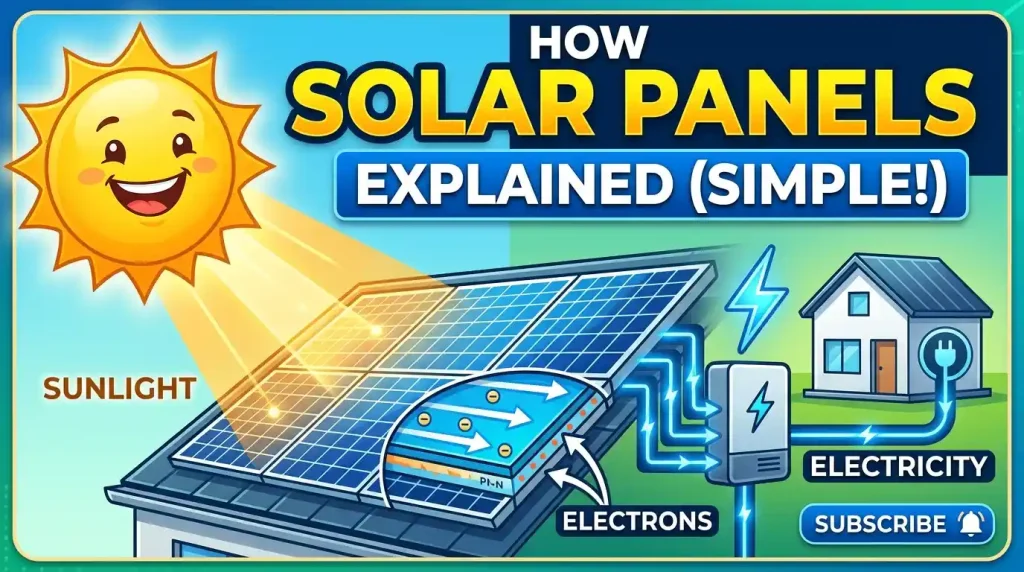
You’ll also see this tool called a “pv solar panel calculator.” PV simply stands for photovoltaic, the technical term for how a solar cell turns sunlight into electricity — see our how solar panels work guide for the full process. A pv solar panel calculator and a solar panel calculator refer to the same underlying tool; PV is just the industry’s shorthand for the technology involved.
Solar Panel Angle Calculator: The Basic Tilt Rule
Your ideal year-round tilt angle roughly equals your latitude. A home at 35° latitude should tilt panels to about 35° from flat ground.
Latitude tells you how high the sun sits in your sky on average across the year. Matching your panel’s tilt to that number keeps it more directly facing the sun’s typical path. Every solar panel angle calculator online is built on this same latitude match, sometimes refined with local weather data.
| Your latitude | Approx. ideal year-round tilt |
|---|---|
| 25° (Miami, FL) | 25° |
| 30° (Houston, TX) | 30° |
| 34° (Los Angeles, CA) | 34° |
| 40° (New York, NY / Denver, CO) | 40° |
| 45° (Portland, OR / Minneapolis, MN) | 45° |
For an exact number tied to your address, the NREL PVWatts calculator pulls your latitude automatically and outputs a recommended tilt without any manual lookup.
Seasonal Tilt: Squeezing Out More Power
Adjusting the angle twice a year can add roughly 8% to 15% more annual energy: set tilt to latitude minus 15° in summer, and latitude plus 15° in winter. At 40° latitude, that’s 25° in summer and 55° in winter. Most roof-mounted panels are bolted at a fixed pitch, so this mainly applies to ground mounts or portable panels you can physically re-tilt using adjustable mounting hardware. For a typical rooftop system, the labor of re-adjusting twice a year rarely pays for itself; it’s mostly worth it for off-grid setups where every watt counts.
Which Direction Should Solar Panels Face?
True south is the best direction for solar panels anywhere in the continental U.S. Direction affects output more than angle does — facing east or west instead of south costs about 20-25% of potential output.
| Direction | Output vs. true south |
|---|---|
| True south | 100% (best) |
| Southeast or southwest | ~85% (lose ~15%) |
| East or west | ~75-80% (lose ~20-25%) |
| North | ~40% (lose ~60%) |
A south-facing panel at a mediocre angle will almost always outperform a perfectly-angled panel facing east or west. If you can only optimize one variable, optimize direction first.
East-West Solar Panel Orientation
Some homes deliberately split panels across east and west roof sections instead of clustering everything south-facing. This trades peak midday output for a flatter production curve, more power in the morning and evening, which can suit homes with high early or late electricity use, or utilities with time-of-use billing that rewards spread-out production.
Solar Panel Angle by Location: Zip Code & State Examples
Your zip code is really a stand-in for your latitude, since tilt depends entirely on how far north or south you live.
Free tools, including the NREL PVWatts calculator linked above, let you enter a zip code and get your exact latitude and recommended tilt automatically. Oregon is a useful example of a higher-latitude state that needs a steeper angle than states further south:
| City | Latitude | Ideal year-round tilt |
|---|---|---|
| Portland | ~45.5° | ~37-45° |
| Salem | ~44.9° | ~37-44° |
| Bend | ~44.1° | ~36-44° |
The exact figure shifts a little depending on whether you use a pure latitude match or a weather-adjusted model, but the high 30s to mid-40s is the right ballpark across most of Oregon.
How Many Solar Panels Do I Need?
Divide your daily energy use by how much one panel produces per day to estimate your panel count: (monthly kWh ÷ 30) ÷ (panel wattage × peak sun hours ÷ 1000).
Example: a home using 900 kWh a month uses about 30 kWh a day. With 400W panels and 5 peak sun hours, each panel makes roughly 1.5 to 2 kWh daily, so the home needs about 15 to 20 panels. For the exact same formula applied to a full 8-20 panel home system, our 400 watt solar panel guide walks through a worked example using national average electricity use.
A solar panel calculator for home use typically asks for three inputs: your average monthly electric bill or kWh usage, your zip code (for peak sun hours), and your roof’s usable space. From those three numbers, it estimates system size in kW, panel count, and a rough price.
Solar Panel Cost Calculator
A solar panel cost calculator estimates total price from your system size and location, typically using a cost-per-watt figure that varies by state and equipment tier.
Once you know how many panels you need from the sizing formula above, multiply your system’s total wattage by a cost-per-watt figure to estimate price. Our solar panel cost per watt guide breaks this down by all 50 states, with national averages currently running $2.50-$3.50 per watt installed.
| Cost input | Typical range |
|---|---|
| Panel-only (DIY hardware) | $0.85 – $1.30/watt |
| Full installed system (national average) | $2.50 – $3.50/watt |
| Commercial systems | $1.80 – $2.50/watt |
For a source outside this site, the Department of Energy’s solar cost benchmarks track these same per-watt figures at a national level and are a useful cross-check against any calculator’s output.
Solar Panel Installation Cost Calculator
An installation cost calculator goes one layer deeper than a basic price-per-watt estimate; it breaks the total down into labor, permits, the inverter, racking, and installer profit, since equipment alone is usually only a quarter to a third of the bill. See our solar panel installation guide for what each of those line items actually covers, or our cost per watt guide for a full breakdown showing roughly how much of a typical invoice goes to each category, useful for sanity-checking a quote that looks unusually high or low.
Commercial and RV Solar Panel Calculators
Commercial and RV calculators use the same core math as home sizing calculators, but adjust for different inputs entirely.
Commercial Solar Panel Calculator
A commercial calculator scales up the residential formula, factoring in three-phase power, larger roof or ground-mount arrays, and business electricity rate structures. For a warehouse or multi-unit building, this is really its own calculation, best handled by a commercial solar designer rather than a homeowner-focused tool.
RV Solar Panel Calculator
An RV calculator answers a different question: not “how many panels for my house,” but “how many panels keep my battery bank charged while traveling.” It factors in battery bank size, daily energy use from your fridge, lights, and electronics, and realistic sun hours while parked. Our RV solar panels guide covers this sizing in more depth.
Solar Panel Charge Time Calculator
A charge time calculator estimates how long a given panel takes to refill a battery from a set charge level, based on panel wattage, battery capacity, and charge controller efficiency. This matters most for van life, boats, and portable power stations rather than rooftop systems.
Electrical Calculators: String, Amps & Voltage Drop
These three tools are wiring and safety calculations, typically handled by installers rather than homeowners doing DIY planning.
Solar Panel String Calculator
A string calculator figures out how many panels can be safely wired together in series before the combined voltage exceeds what your inverter can handle. Wiring too many panels into one string risks damaging the inverter or tripping a safety limit.
Solar Panel Amps Calculator
An amps calculator sizes wiring and breakers correctly based on how many amps your panels and system will produce. Undersized wiring can overheat; oversized wiring wastes money on unnecessary copper.
Voltage Drop Calculator for Solar Panels
A voltage drop calculator estimates how much power is lost over a wire run, based on gauge and distance. Long runs, common in ground-mount or detached-garage setups, can lose meaningful output if the gauge is too thin.
If you’re a homeowner just working out panel angle or panel count, you can skip these three. If you’re wiring your own system, these calculations matter, and mistakes here are a real fire risk, not just a performance issue.
Solar Panel Layout Tool
A layout tool is a visual planner that maps where panels will physically sit on your roof, accounting for vents, chimneys, shading, and fire-code setback requirements.
Most professional solar quotes today include a satellite-based layout tool as part of the proposal, letting you see exactly how many panels fit and where before you sign anything.
Does a 400W Solar Panel Really Produce 400W?
No, not continuously. 400 watts is a panel’s rated output under lab conditions; real-world output is closer to 1.5 to 2.5 kWh across a full day, not a steady 400 watts for hours.
Angle and direction are two of the biggest levers for closing that gap between rated and real output, which is exactly why a solar panel calculator matters more than the sticker wattage alone. Our 400 watt solar panel guide covers real-world daily output ranges by climate in more detail.
What Is the 120% Rule for Solar Panels?
The 120% rule comes from NEC 705.12 and limits how much solar power can safely connect to your home’s electrical panel alongside grid power.
Your main breaker rating plus your solar breaker’s output can’t exceed 120% of your panel’s busbar rating. For a typical 200-amp panel, this often caps system size around 7.5-8 kW without an electrical upgrade. Larger planned systems may need a downsized main breaker, a sub-panel, or a different connection method to stay code-compliant.
The Biggest Misconception About Solar Angle
The myth: “if my panels aren’t at the perfect angle, they’re wasting a ton of power.” That’s an exaggeration. Being 10-15° off the ideal tilt typically costs only 2-5% of annual output, barely noticeable on a bill. Direction is the bigger factor: facing 90° off true south costs 20-25%. For most homes, a roof’s existing pitch is close enough to optimal that a costly tilt-adjusting rack isn’t worth the money.
Practical Installation Tips
- Don’t over-invest in adjustable tilt racks for rooftop systems; the energy gain rarely justifies the added cost.
- Prioritize an unshaded, south-facing roof section over chasing a perfect tilt angle.
- If your roof isn’t south-facing, southeast or southwest sections are still solid, with only a modest loss.
- For ground-mount or portable setups, seasonal tilt adjustment is more worth the effort, since roof pitch isn’t a constraint.
- Check your electrical panel’s capacity against the 120% rule before finalizing system size.
Glossary of Solar Panel Calculator Terms
- PV
- Short for photovoltaic, the process of converting sunlight directly into electricity.
- Tilt angle
- How steeply a panel is angled from flat ground, ideally close to your latitude.
- Peak sun hours
- The number of hours per day of sunlight strong enough to count as “full sun” for output estimates.
- String
- A set of panels wired together in series before connecting to an inverter.
- 120% rule
- An NEC electrical code limit on how much solar power can be added to a home’s main panel.
Frequently Asked Questions
How do I calculate how many solar panels I need?
Divide your daily energy use in kWh by how much a single panel produces per day, usually 1.5 to 2.5 kWh for a 400W panel, based on your local peak sun hours. Example: 30 kWh/day ÷ 1.75 kWh/panel ≈ 17 panels.
What is the best angle for a solar panel calculator to recommend?
Roughly your latitude. A home at 40° latitude should expect a recommendation close to a 40° fixed tilt for year-round output, adjustable seasonally if the setup allows it.
Does a 400W solar panel produce 400W?
Only under perfect lab conditions. In real use, it produces the equivalent of 1.5 to 2.5 kWh across a full day, not a steady 400 watts continuously.
What is the 120% rule for solar panels?
An NEC electrical code rule (705.12) limiting how much solar power can be safely added to a home’s main electrical panel, often capping systems around 7.5-8 kW on a standard 200-amp panel without an upgrade.
What direction should solar panels face?
True south, for anywhere in the continental U.S. This gives panels the most consistent sun exposure across the day and year, losing only about 15% of output even if shifted to southeast or southwest.
A solar panel calculator is really a family of tools, not one single thing. Get your direction right first, since it affects output more than angle does. Use the latitude-based tilt tables above as a starting point, then run your usage through the sizing formula to land on a panel count, and cross-check any price estimate against a per-watt cost calculator before you sign a quote.