Different Types of Solar Panels: A Complete Comparison Guide
Every one of the different types of solar panels looks similar in a brochure. On your roof, they perform very differently. Here’s how to tell them apart before you buy.
Not all solar panels are built the same way. Two panels can look almost the same on a spec sheet and still perform very differently on your roof. The difference comes down to the silicon inside, how it’s made, and the materials used under the glass.
This guide breaks down every major type of solar panel sold in the U.S. today — how each one works, where it performs best, and which one fits your roof, budget, and climate. Once you understand the different types of solar panels, reading a real quote or spec sheet gets a lot easier.
Key takeaways
Here’s a quick summary before we get into the different types of solar panels in detail:
- Monocrystalline panels are the most efficient and the standard choice for most home roofs today.
- Polycrystalline panels cost less to make, but most installers have moved away from them as monocrystalline prices dropped.
- Thin-film panels are light and flexible. They work best for RVs, boats, and large commercial roofs — not typical homes.
- Bifacial (glass-glass) panels capture light on both sides, which helps on ground-mount and elevated systems.
- Newer cell technologies like TOPCon and HJT now outperform older monocrystalline designs in heat and long-term output.
Quick comparison: different types of solar panels at a glance
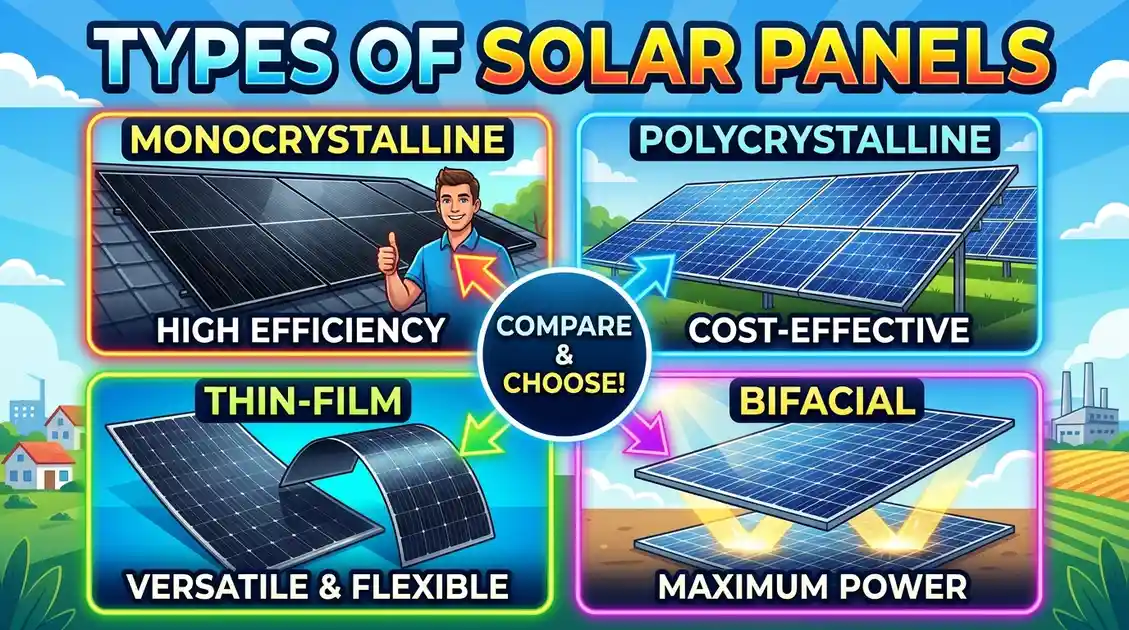
Monocrystalline, polycrystalline, thin-film, and bifacial panels differ most in efficiency and cost per watt. Monocrystalline leads on output, polycrystalline and thin-film cost less upfront, and bifacial adds rear-side gain on ground-mount systems. The table below lines up all five options side by side.
| Type | Efficiency | Cost per watt | Best for |
|---|---|---|---|
| Monocrystalline | 20–23%+ | $1.00–$1.50 | Most home roofs, small roofs |
| Polycrystalline | 15–18% | $0.70–$1.00 | Large roofs, tight budgets |
| Thin-Film (CdTe, CIGS, a-Si) | 10–18% | $0.45–$0.70 | RVs, boats, commercial roofs |
| Bifacial (glass-glass) | 21–23%+ (plus rear-side gain) | $1.10–$1.60 | Ground-mount, carports, commercial |
| Solar shingles | 14–18% | $4.00–$8.00 (installed) | Homeowners who want a low-profile look |
Cost ranges reflect national averages for equipment and installation; your local price may vary. Source: U.S. Department of Energy solar cost benchmarks. For a full state-by-state breakdown, see our solar panel pricing by state guide.
Monocrystalline solar panels
Monocrystalline panels are cut from one continuous silicon crystal, which lets electricity flow through them with less resistance than other types. That single-crystal structure is why they top the efficiency charts among residential solar panel options, typically reaching 20–23%+ efficiency.
Workers grow the crystal into a tall cylinder, called an ingot, then slice it into thin wafers before assembling them into a panel.
Why monocrystalline panels look black
The single-crystal structure absorbs almost all the light that hits it. That’s what gives these panels their deep, solid black look, with no specks or fragments.
Monocrystalline downsides
The main drawback is cost. Cutting square wafers from a round ingot wastes some silicon, which raises the price. Monocrystalline cells are also a bit more sensitive to cracks from impact, though this rarely causes real problems in normal use.
N-type vs. P-type monocrystalline
Almost every silicon solar cell is treated with either boron or phosphorus to create the electrical charge it needs to work. This is called doping.
- P-type has been the industry standard for decades. It costs less to make, but it loses a small amount of output during its first months in the sun. This is called light-induced degradation.
- N-type is the newer, premium standard. It degrades more slowly, handles heat better, and usually comes with a longer warranty. It costs more upfront.
If long-term output matters more to you than the sticker price, N-type is usually the better pick.
Modern cell technology: PERC, TOPCon, HJT, and IBC
Not every monocrystalline panel uses the same cell design under the glass. Here’s how the four common designs compare:
| Cell type | What it is | Why it matters |
|---|---|---|
| PERC | Passivated Emitter and Rear Cell | The older p-type standard through the early 2020s. Still common on installed systems, but being phased out for newer designs. |
| TOPCon | Tunnel Oxide Passivated Contact | An n-type design that became the mainstream residential choice by 2024–2025. NREL projects it will lead the market going forward, with low degradation rates in top-tier modules. |
| HJT (Heterojunction) | Combines crystalline and thin-film layers | A premium n-type option with strong heat performance and long degradation warranties. |
| IBC (Interdigitated Back Contact) | Moves electrical contacts to the back of the cell | Frees up the front surface to catch more light. Used by premium brands. Usually the most expensive option. |
Polycrystalline solar panels
Polycrystalline panels are made by melting many small silicon fragments together into one wafer, instead of growing a single pure crystal. That mixed structure makes them cheaper to produce but slightly less efficient (15–18%) than monocrystalline panels.
Sometimes called “multi-crystalline” panels, they cost less upfront and waste almost no silicon in manufacturing, but the mixed crystal structure doesn’t conduct electricity quite as well as a single crystal does.
You can spot polycrystalline panels by their blue, speckled look. This comes from light bouncing off the many small crystal fragments inside each cell.
Polycrystalline panels remain a decent budget option if you have plenty of unshaded roof space, where a small efficiency gap matters less than the upfront price. That said, as monocrystalline prices have fallen, most U.S. residential installers now only offer monocrystalline for new installs.
Thin-film solar panels
Thin-film panels place a very thin layer of light-absorbing material onto a backing surface — glass, metal, or plastic — instead of using thick silicon wafers. That makes them lighter, more flexible, and cheaper to produce, but less efficient than crystalline panels.
There are three common thin-film types:
- CdTe (Cadmium Telluride): The most widely made thin-film type at commercial scale. It performs well in high heat and low light.
- CIGS (Copper Indium Gallium Selenide): A middle ground between flexibility and efficiency. Often used in specialty and semi-flexible products.
- Amorphous Silicon (a-Si): The least efficient but most flexible and lightweight option. Common in small portable electronics and low-power uses.
Thin-film panels usually aren’t the first choice for a typical home roof, since you’d need much more surface area to match monocrystalline output. But they’re a strong fit for large commercial buildings, curved surfaces, and weight-sensitive uses like RV solar setups and portable solar panels for boats.
Bifacial and glass solar panels
A bifacial panel uses glass on both the front and back instead of a standard plastic backing, which lets it capture reflected light on its rear side in addition to direct sunlight on the front. That boosts total output, especially on ground-mount or elevated systems where light can bounce off the surface underneath.
On a typical rooftop over a dark shingle roof, the rear-side gain is usually small. Ask your installer whether bifacial makes sense for your specific setup before paying the price premium.
Solar shingles: an alternative to panels
Solar shingles use the same underlying photovoltaic technology as standard panels, but they’re built to replace your roofing material itself, so they lie flat and blend in. They’re the option to consider if the look of solar panels bothers you.
Solar shingles run about 14–18% efficient, similar to mid-range thin-film. The tradeoff is cost: they run several times more per watt than standard panels, and supply is limited compared to standard rooftop panels. Most systems, including the Tesla Solar Roof, only work on roofs being fully replaced, not added on top of existing shingles.
Types of solar panel connectors
Solar panel connectors are the weatherproof plugs that link panels to each other and to the rest of the system. The connector type affects safety, compatibility, and how easily panels can be added or swapped later — worth checking before you buy, whatever panel type you choose.
| Connector type | What it is | Where you’ll see it |
|---|---|---|
| MC4 | The industry-standard locking connector used across nearly all residential and commercial panels today. | Almost every monocrystalline, polycrystalline, and bifacial panel sold in the U.S. |
| MC3 | An older, non-locking predecessor to MC4. | Legacy systems installed before MC4 became standard; rarely used in new installs. |
| SAE / Anderson connectors | Compact, snap-together connectors built for lower-voltage DC use. | Portable solar panels, RVs, and boats. |
| Proprietary microinverter connectors | Manufacturer-specific plugs paired with a microinverter or power optimizer on each panel. | Systems using microinverter brands like Enphase. |
MC4 connectors are the safe default for most rooftop installs, since nearly every major panel brand and inverter is built to work with them. If you’re mixing panel types, ask your installer to confirm connector compatibility before wiring anything together.
How much do different solar panel types cost?
Pricing is one of the biggest differences between the types of solar panels on the market. Here’s how they compare per watt:
| Panel type | Cost per watt |
|---|---|
| Monocrystalline | $1.00–$1.50 |
| Polycrystalline | $0.70–$1.00 |
| CIGS thin-film | $0.60–$0.70 |
| CdTe thin-film | $0.50–$0.60 |
| Amorphous (a-Si) thin-film | $0.43–$0.50 |
| Solar shingles | $4.00–$8.00 (fully installed) |
Monocrystalline costs more per watt, but you often need fewer panels to hit the same power target. That can offset some of the extra cost through lower labor and racking expenses. Run your own numbers with our solar panel calculator, or see the full installation cost breakdown.
Power output by panel type
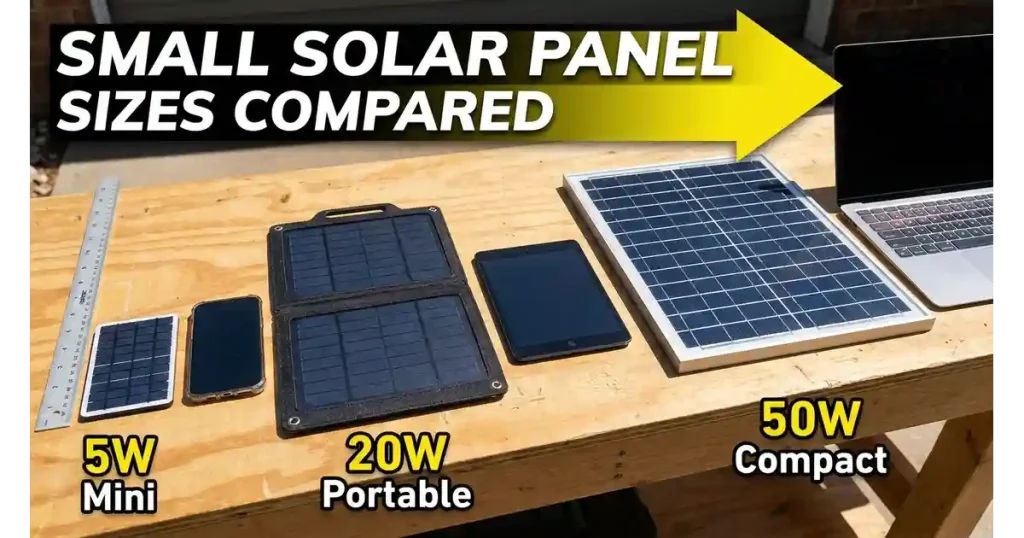
Most residential panels sold today produce between 250 and 450 watts each.
- Monocrystalline: Typically 350–450 watts per panel — see our 400-watt solar panel breakdown for a common mid-range example.
- Polycrystalline: Typically 240–300 watts per panel.
- Thin-film: No standard size, so output varies with the physical size of the panel.
Warranty and lifespan by panel type
| Panel type | Typical warranty | Service life |
|---|---|---|
| Monocrystalline | 25–30 years | 25–30+ years |
| Polycrystalline | 25 years | 25–28 years |
| Thin-film | 20–25 years | 20–25 years, shorter under mechanical stress |
Ask your installer for the annual degradation rate, not just the warranty length. A panel that loses 0.3% of its output per year will out-produce one losing 0.5% per year by a meaningful amount over 25 years. Regular upkeep also protects that output — see our guides to solar panel maintenance and solar panel cleaning costs.
Weather and durability ratings
Your climate should shape which panel type and rating you choose.
Hail rating
Most panels are certified to handle 1-inch hail falling at around 50 mph. Monocrystalline and polycrystalline panels, protected by tempered glass, hold up well. Thin-film’s thinner design makes it less ideal in hail-prone areas.
Hurricane and wind rating
There’s no single national hurricane rating for solar panels, but most rooftop systems are rated to withstand winds up to 140 mph when properly secured with the right mounting hardware.
Temperature performance
Solar panels work best around 77°F. Output drops as panels get hotter than that. Panels with a lower temperature coefficient — common in N-type monocrystalline and CdTe thin-film — lose less output on very hot days.
Fire rating
Solar panels must match the fire rating of the roof they sit on, using the same Class A, B, or C system used for roofing materials.
Best type of solar panel by use case
There’s no single best type of solar panel for every situation — it depends on what you’re optimizing for: efficiency, budget, weight, or looks. Match the panel type below to your priority, and if you’re still weighing whether solar is worth it at all, that’s worth settling first.
- Best for maximum efficiency: N-type monocrystalline (TOPCon or HJT)
- Best for tight budgets with available roof space: Polycrystalline
- Best for flexibility and low weight: Thin-film
- Best for ground-mount output: Bifacial glass-glass
- Best for a low-profile look: Solar shingles
Frequently asked questions
What are the four main types of solar panels?
Most industry sources point to monocrystalline, polycrystalline, thin-film, and bifacial (or PERC-enhanced) panels as the four main categories sold today.
Which is better, N-type or P-type solar panels?
N-type panels generally perform better long-term. They degrade more slowly, handle heat better, and often carry longer warranties. P-type panels cost less upfront.
What are the disadvantages of monocrystalline panels?
The main disadvantages are a higher upfront cost, caused by silicon waste during manufacturing, and slightly more sensitivity to physical damage than some newer cell designs.
What does “PV solar panel” mean?
PV stands for photovoltaic, the general term for any solar cell that turns sunlight directly into electricity. It’s an umbrella term covering monocrystalline, polycrystalline, thin-film, and bifacial panels alike.
What is the most common type of solar panel connector?
MC4 is the most common solar panel connector. It’s the industry-standard locking plug used on nearly all residential and commercial panels sold in the U.S. today.
Which type of solar panel is best for a home roof?
For most homes, N-type monocrystalline panels are the best type of solar panel. They deliver the highest output per square foot, which matters most on a typical residential roof.